It’s bizarre today to think of Rockstar working on games that aren’t Grand Theft Auto. Frankly, it’s bizarre to think of Rockstar working on games that aren’t GTA 6, which rolls onto console hard drives this week. A decade in the making, with a development team of thousands scattered across an international network of studios, GTA 6 aims to be the Maximum Game. It’s both a dense, lively open world and a monument to the exhausting impersonality of “triple-A” game productions. It contains multitudes: birdlife! Realistic cloud formation! Fuel mechanics! Romance! Soda visibly sloshing around in bottles! It’s an imperial production shadowed by labour disputes, that appears to have given Rockstar’s various teams little time or space to think about anything else.
It wasn’t ever thus. Once upon a time, Rockstar weren’t just known for GTA and to a considerably lesser extent, Red Dead Redemption. Once upon a time, they had a reputation for slightly dodgy experiments. I recently interviewed former Rockstar North tech director Obbe Vermeij about a few of them, including Agent, the unofficial James Bond game Rockstar toyed with before putting all chips on Grand Theft Auto 5.
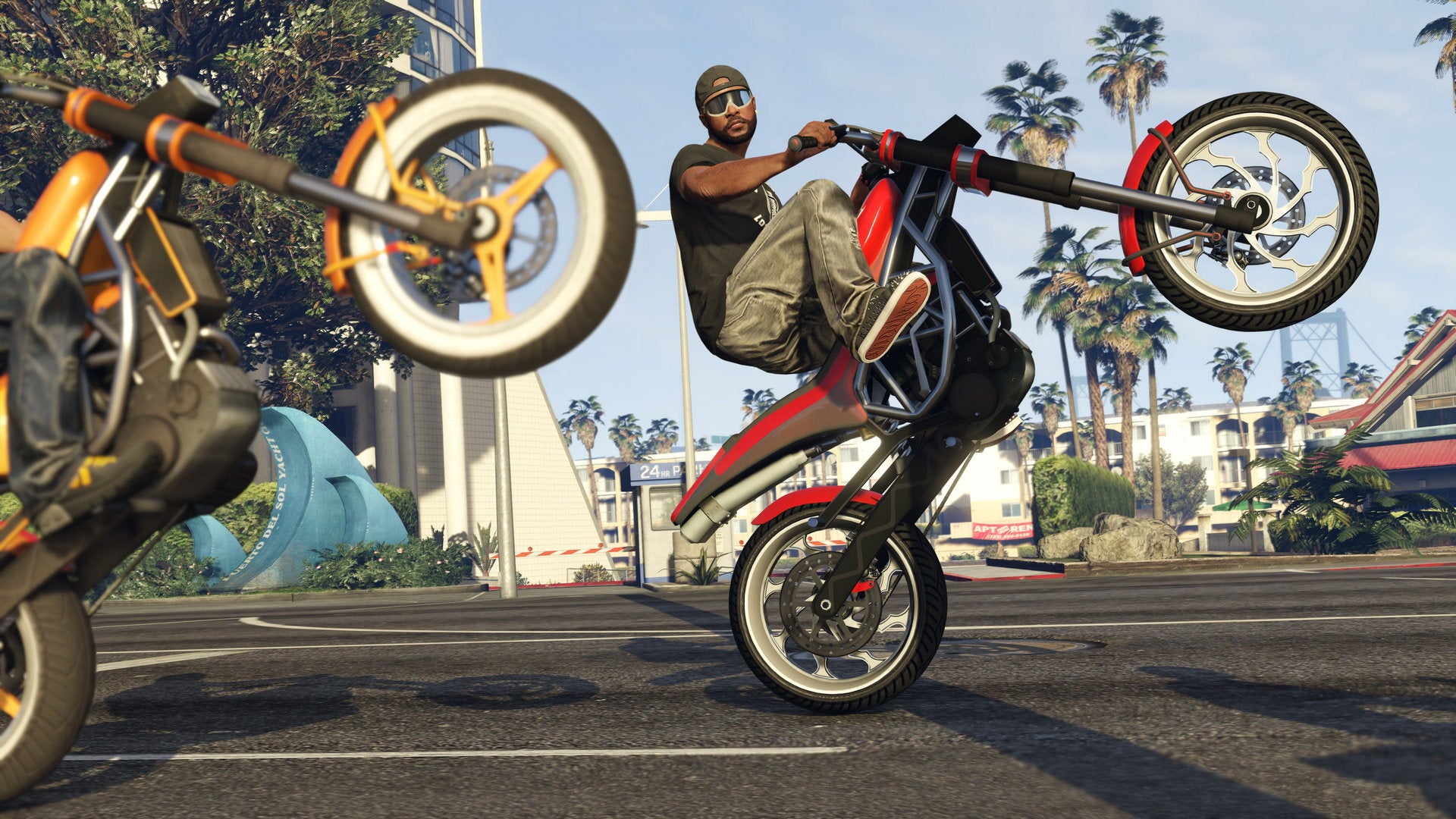
During the noughties especially, when the most expensive games took considerably less time to make, Rockstar tried their hand at a number of projects besides GTA. There was 2002’s Manhunt, a rancid parody of snuff films – not much loved, but sufficiently admired to spawn a sequel in the hands of Rockstar London. There was 2005’s adaptation of Walter Hill flick The Warriors – a mouthy Homeric beat ’em up in which you cross New York on foot over the course of a single night – and 2006’s Rockstar Presents Table Tennis – an inexplicable pivot towards realistic sports simulation from Rockstar San Diego. Later in 2006 came Bully, aka Canis Canem Edit, a boarding school life sim from Rockstar Vancouver (née Barking Dog Studios). I didn’t warm to Bully, myself, but I’ve never been able to get its sardonic OST out of my head.
In amongst all these, Rockstar weighed up several game projects that never made it out of the building. The aforesaid Agent is perhaps the best-known, but my conversation with Vermeij (who worked at Rockstar from 1995 to 2009) began with “Z”, a fleeting attempt to expand into the world of zombie action games, which Rockstar spent a few weeks mulling over in the wake of Grand Theft Auto: Vice City. It was set in the islands of Scotland, which would have made it the only Rockstar North project to unfold in the studio’s backyard. “I think it was meant to be smaller than GTA, map-wise, and there weren’t going to be any deserted cities – it was really just islands and some villages,” Vermeij told me. “But it really didn’t get that far.”
The pitch for Z couldn’t be further from the sweat and glitter of GTA 6’s Miami, but the two projects would have shared a taste for ‘simulation’ elements. “It actually was going to have cars running out of fuel,” Vermeij told me. “That was going to be one of the things, and the whole idea was that you’d find cars and they’d only have a little bit of fuel in them.” As for why Z never entered full development, turns out desolate North Atlantic archipelagos full of corpses can be a bit of a downer. “Everybody was super excited to do something new,” Vermeij went on. “And then pretty quickly, we kind of realised that it’s really just a depressing version of GTA, and it sort of died.”
The increasing success of Grand Theft Auto during these years was something of a “curse”, Vermeij went on. It meant that a lot of Rockstar’s ventures beyond GTA were eventually folded back into the series. “It’s very difficult to have a studio and have one mega game, and then do something on the side,” he explained. “It’s almost impossible, because at any time during the development of the smaller project, management’s going to say ‘oh! The big project’s in trouble. We need more people.’ And they’re just going to pull everybody from that small team onto the big team, so even if we had progressed with [Z], what would have happened is we would have had to start GTA 4 at the same time, and eventually the small team would just be merged with the big team again.”

Rockstar’s Bondalike game Agent got a lot further down the road to release than Z. It was in development for several years following GTA 4’s launch, and was touted by co-founder Sam Houser as Rockstar’s next megagame. “A lot of work had been done on that,” Vermeij recalled. “And then we ended up just cutting and cutting it, because the same thing happened – at some point you kind of go OK, well, we better get on with the next GTA.”
Agent sounds like it could have been a hoot, at least going by Vermeij’s description of his own time with the project. It was a relatively linear, level-based action game with a touch of camp. “There was a French ski resort, and there was going to be a Mediterranean town like San Tropez, somewhere like that,” Vermeij explained. “There was going to be a North African place, like Morocco or Egypt. The last level was going to be on the moon, with lasers – like Moonraker. There was another one, London or something, I can’t remember. But then we just ended up cutting everything down, because what we could see happening was that at some point, we would have to go back to work on GTA. It wasn’t close to being finished.”
While never a spoof in the vein of Austin Powers, Agent would have been a sillier production than the grimy and downbeat GTA 4. “It was meant to lean into all the cliches,” Vermeij said. “It was like James Bond from the 1970s – there was a girl with white boots. It wasn’t a comedy, it was just completely over-the-top cliched.”
As for the choice of a level-based format, this came from a desire for variety the studio couldn’t realistically achieve in a GTA-style open world. “If you had to have them all on one map, you would basically have had to model a mini version of Europe,” Vermeij said, “So you couldn’t do that.” Players might have been able to revisit locations containing several missions, which calls to mind Io Interactive’s later Hitman: World of Assassination games, to say nothing of their own bash at the Flemingverse, 007 First Light. “I don’t how whether it was going to be completely linear, or whether you were always going to be able to visit all those locations.” Vermeij said.
Needless to say, Rockstar’s Bondalike would have featured chase scenes. Vermeij himself worked on the moving parts. “I remember doing some work on what we called the car recording stuff for GTA,” he went on. “So if a level designer wanted to set up a chase scene, they would drive one car, record it, and then play back the recording, drive a second car and record that… and so driving one by one, you could set up a whole chase scene. I did a version of that for [human] characters as well, because for one of the Agent missions in the French ski resort, there was like a chase where the bad guys were on skiis and using their machine guns. So I set up a thing where you’d play them one by one, and then play the whole thing back. There was maybe like five or six bad guys and they’d ski after you, and then it was just up to the player to avoid them.”

According to Vermeij, Agent never had a defined story during his time with it. It was more of a mix of scenario concepts, “kind of how we used to do games with GTA 3 and Vice City”. Mind you, the absence of a nailed-down plot isn’t necessarily a sign that Agent was lightyears from being finished. Even at their most byzantine, Bond movie plotlines often feel like an afterthought. “It’s like oh yeah, there’s a bad guy and there’s a thingally-dingally that needs to be captured before the world comes to an end,” summarised Vermeij. Still, Agent would spend a long time in limbo after Vermeij left. It’s still unclear how much it was in active development before Rockstar’s trademark finally evaporated in November 2018.
One thing I learned while reading up on Rockstar’s checkered history was that GTA 3, the game that made GTA a Thing on PlayStation, wasn’t deemed an immediate hit at launch. According to Vermeij himself, it was months before Rockstar realised what they’d built. This inspired an obvious closing question: what might Rockstar have done, if GTA 3 hadn’t blown up the way it did? Which of those other projects might have become the focus?
“I really have never thought about it,” Vermeij pondered. “When Rockstar San Diego joined, it was 2002, and they already had a bunch of games and a bunch of franchises, like Midnight Club and Smuggler’s Run. They were already into driving games and city games in that way, so it wouldn’t have surprised me if we’d gone in that direction anyway. But then they were more about car modding and decals and stuff like that.
“At Rockstar North, we only had Manhunt and GTA,” he went on. “With Manhunt, that team was in development hell for a while, they had a couple of rough years where they got stuck and in the end, they pulled through, and they got a pretty decent game. But I don’t think that would have been the future. I don’t think [Rockstar North] would have done a Manhunt 2. So yeah, it would be Table Tennis, I think! Everything on Table Tennis!”


