Bit of an anticlimax, really. After months of (justified) revulsion and anti-anticipation over Nvidia DLSS 5’s AI rendering, it’s now available in a live game – license laden b-baller NBA 2K27 – and it looks… maybe not that bad?
This not-that-badness does come at an enormous cost to performance, and I’m still sceptical of how DLSS 5 will handle something more stylised than 2K27’s devotedly realistic depictions of varnished court floors and face-scanned athletes. But given how artistically botching and/or ridden with rendering errors the earlier previews have been, this specific implementation, in this specific game, is at least inoffensive in the looks department.
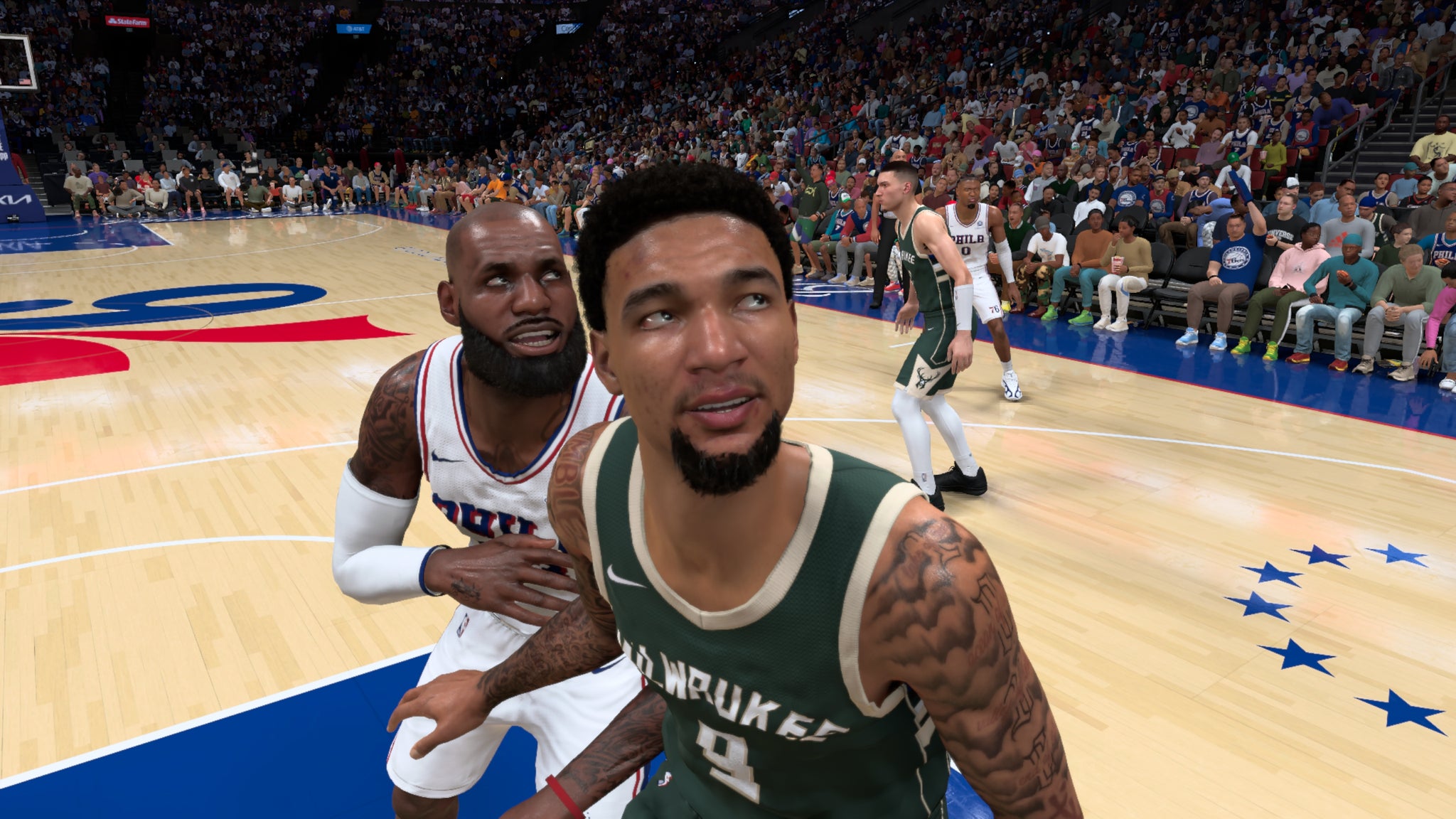

Since DLSS 5 only currently has official support on RTX 50 series graphics cards, I tried it on two: an RTX 5080 at 1440p and an RTX 5050 at 1080p, both on top of Ultra settings with ray traced reflections and Quality-level DLSS upscaling enabled. And on both setups, it’s hard to argue that DLSS 5 slobbers filterslop all over NBA 2K27’s original artistic intent.
It probably helps, to stress the point, when the intention is already photorealism, the same goal that Nvidia explicitly identify as DLSS 5’s raison d’etre. Your brain likely expects 2K27’s players to resemble their real-life counterparts, in a similar way to how it wouldn’t expect Resident Evil Requiem to look like it was posted by a blue-ticked X user with the caption “Hollywood is finished lol”. As such, when DLSS 5 rocks up and makes their skin slightly sweatier or their vests slightly more textured, it doesn’t look wrong. It doesn’t even ‘look like AI’, to my eyes – even in motion, there’s none of the artificial, overly glossy smoothness typical of fully genAI visuals.
Attribution
DLSS 5 off
Crucially, there are few signs of the excess detailing and outright errors that were evident in pre-release material, outside of some unnecessary eye-darkening. Facial structures appear unchanged – there’s no evidence DLSS 5 ever did literally reshape character model geometry, but its combination of visual changes did produce a facelift effect in certain promo shots – and darker skin tones aren’t uncomfortably lightened. The original reveal also included a warping football that suggested DLSS 5 would have frame gen-style problems rendering fast-moving objects, but the ball in the hands of a sprinting 2K27 dunksman remains steadfastly spherical. As well as it can with upscaling and motion blur, anyway.


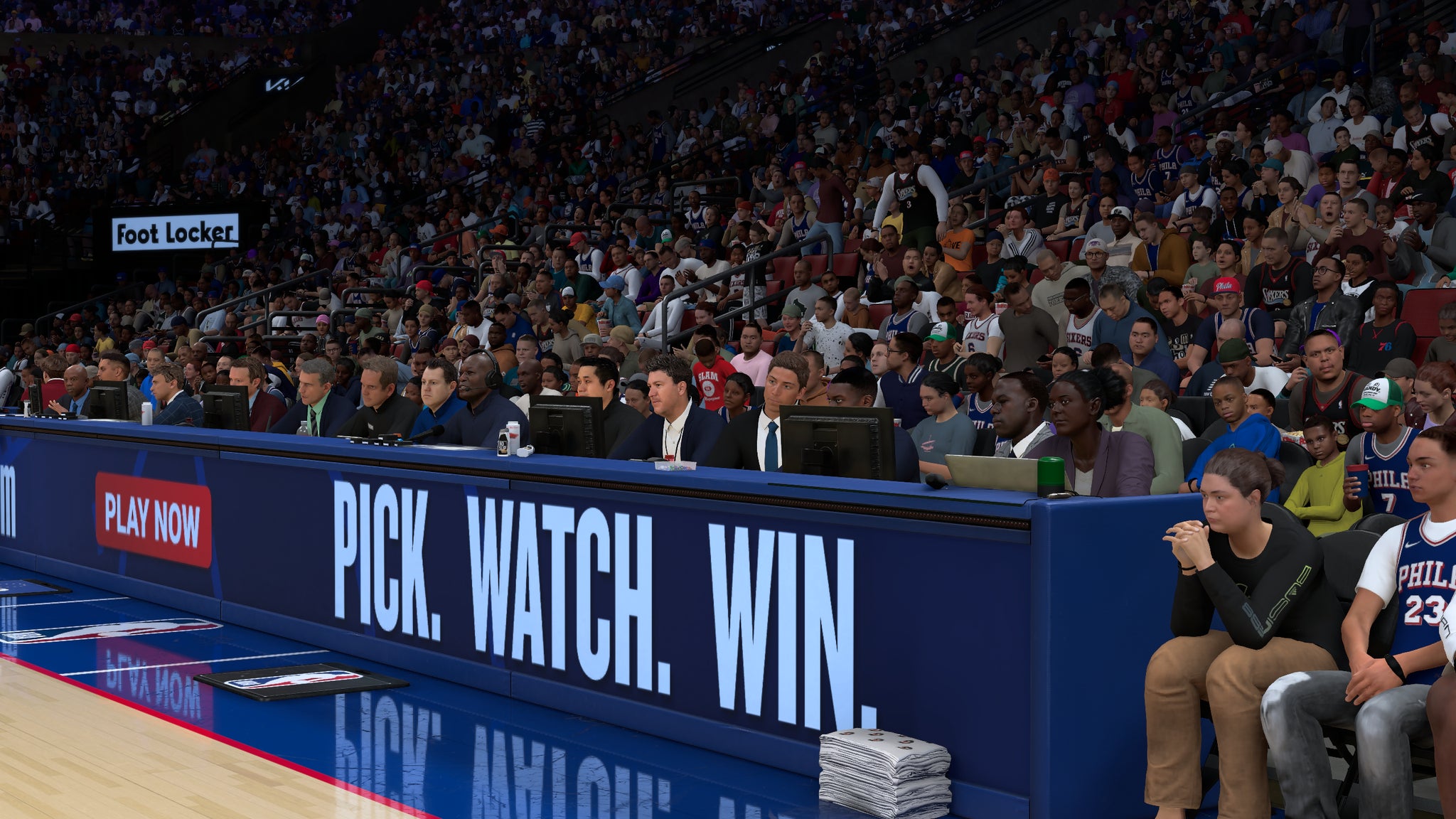
Zoomed out with the default game cam, it even becomes hard to tell where DLSS 5 is having an effect and where it isn’t; I suspect developers Visual Concepts have simply made use of its masking feature to apply neural rendering to objects selectively, as opposed to essentially whacking a filter over the entire image. Either way, it’s a not-unpleasant surprise to see DLSS 5 still looking like a game here, rather than an AI-generated approximation of one.
Whether that stays true in other games – those that don’t share NBA 2K27’s love of photorealism – remains to be seen. DLSS 5 sidesteps many of the ethical problems with genAI: its machinations take place on your GPU, instead of an earthslaying data centre, and it functions as a glorified upscaler for existing art, rather than pretending to be original art itself. Yet because its model isn’t trained on a per-game basis, I don’t think it’s unfair to be worried about its potential to give supporting games a samey, unified look, much like the averaged-out tone of generated AI text, or how AI videos tend to have a certain giveaway sheen. Nvidia have said much about preserving artistic intent, and DLSS 5’s inclusion of dev-side masking and intensity adjustment tools are worth noting, but we won’t have a full idea of how flexible and faithful it can be until it expands beyond one sports sim.
DLSS 5 also has a more immediate drawback: performance. My RTX 5080 lost 54% of its 2K27 framerate at 1440p: an average 211fps dropped to 98fps with a single flick of the neural rendering toggle. With the diminishing returns of ultra-high framerates, that may not be ruinous in practice. The RTX 5050, however, took a sound thrashing at 1080p. 137fps with Ultra settings and ray tracing, a fine showing even with help from Quality-level upscaling, plummeted to 44fps with DLSS 5 enabled – a 67% performance tax. And as reassuring as it is to see the tech’s visuals showing some restraint, you can’t really say it looks 67% nicer.
NBA 2K27 has DLSS 4’s Multi-Frame Generation to make up the difference, though this genuinely is too much AI, too fast. While MFG objectively gets the numbers up, 3x mode averaging 99fps on the RTX 5050 (and 6x mode reaching 135fps), it still hurls back in your face all the same vexations that frame generation has produced since DLSS 3. 3x mode was enough to distort details – you can see the bending player ID tag and the ball thrower’s disintegrating hand in the screenshot below – while 6x added nastily edge distortions and ghosting effects. Considering the whole point of DLSS 5 is to make games look more realistic, MFG evidently isn’t the answer to its frame hunger, and that’s even before getting into frame gen’s added input lag.


I’m told that Nvidia are actively working to improve DLSS 5 performance on 50 series cards, after which they’ll switch focus to RTX 40 series support. That’s fine, though for all the grossness of that original reveal, and all the subsequent charm offensives about respecting intent, and all the resurging RTX On memes, it’s almost funny that NBA 2K27’s launch version of DLSS 5 is basically just the equivalent of path tracing with extra machine learning: a noticeable, if benign and selective graphical upgrade that’s just too demanding to be within reach of most PCs.
All the same, it could have been so, so much worse. I generally detest generative AI and the world it’s creating, where I can’t even trust that a freelance pitch in my inbox has been written by a living human. But I also believe in being a factually accurate hater, and factually, a DLSS 5-ified BA 2K27 still looks like NBA 2K27, mainly just with extra pores and perspiration. A decent start, aesthetically, even if it still has much to prove in future implementations.


