On May 10, 2006, Ritual Entertainment released SiN Episodes: Emergence, the first of nine episodes set in the sci-fi megalopolis of Freeport City. Backed by Valve and launched on Steam just a month before Valve’s own Half-Life 2: Episode 1, the game felt like it was the start of something new. Ritual even had Gabe Newell singing their significance, saying in Emergence’s launch day press release that “With the release of SiN Episodes: Emergence Ritual is leading the industry’s long overdue migration to producing episodic content.”
Valve famously released just two Half-Life episodes before stalling. Ritual only ever managed one.
But, as I learned when talking to some of its creators, SiN Episodes: Emergence is much more than a hiccup in the history of gaming, it was a title torn between the old publishing traditions of the 90s and newly emerging technologies of the 00s. They also told me about the time they “faked the shit out of” all the screenshots for a PC Gamer exclusive.
Long before SiN Episodes, there was SiN. Ritual’s bombastic 1998 shooter introduced players to the crime-ridden setting of Freeport City, to musclebound protagonist Colonel John R. Blade, and antagonist Elexis Sinclaire, who Ritual described as “the world’s most dangerous and seductive biochemist”.
It was a distillation of some of the strongest flavours in 90s shooter design, bringing together the gory violence, easter-egg-packed levels, and lads-mag gender politics of influences such as Doom, Quake, and Duke Nukem. “It’s kind of the last shooter of its kind,” according to Stephen Kick, CEO of Nightdive Studios, custodian of the SiN IP, and currently working on a remaster of the original 1998 game. “It’s a time capsule that sums up the generation of gaming before it.”
But SiN had the profound misfortune of launching two weeks before Half-Life. “One of those games went on to win hundreds of game of the year awards and basically defined the next generation of FPS games,” Kick says. “And one of them didn’t. That was SiN.” Now, it’s unclear to me whether or not SiN would have conquered the world had it hit the market a year earlier, but whatever the case, other than an expansion pack, Wages of SiN, that followed a few months later, John Blade seemed to quietly retire from public view.
But Ritual Entertainment co-founder and creative director Robert M. Atkins wasn’t willing to give up on the series. Unbeknown to many of his colleagues, Atkins continued to spend every spare dev cycle working with his concept artists on new characters, environments, and ideas for the SiN universe – waiting and hoping for the opportunity to return to Freeport City.
And then the creators of Half-Life got in touch.
“Valve had launched Steam and they came to us maybe a couple of months before E3 2005,” Atkins explains. “And they said ‘we would like you guys to take the Source engine and work on the SiN franchise with it. And we’d like you to launch it on Steam’. We were like, holy shit.”
This offer did, however, come with some strings attached. The most immediate of which was the fact that Valve’s VP of marketing, Doug Lombardi, wanted to announce the game at E3 and hand an exclusive cover story to the UK edition of cheery RPS fanzine PC Gamer.
“E3 was, I don’t know, less than a month away,” Atkins tells me. “And I remember I was sitting in the conference room with my co-founders and I said: you guys go to E3. I want to have full access to the entire studio while you guys are gone. All the designers, all the art team. I’ll take what I’ve been working on, I’ll direct them, and we’ll come up with all the content for this PC Gamer magazine, and I’ll make it look like this game is fucking badass.”
How do you make a game that hasn’t yet entered production look ‘fucking baddass’? As it turns out, the process involves taking some creative liberties.
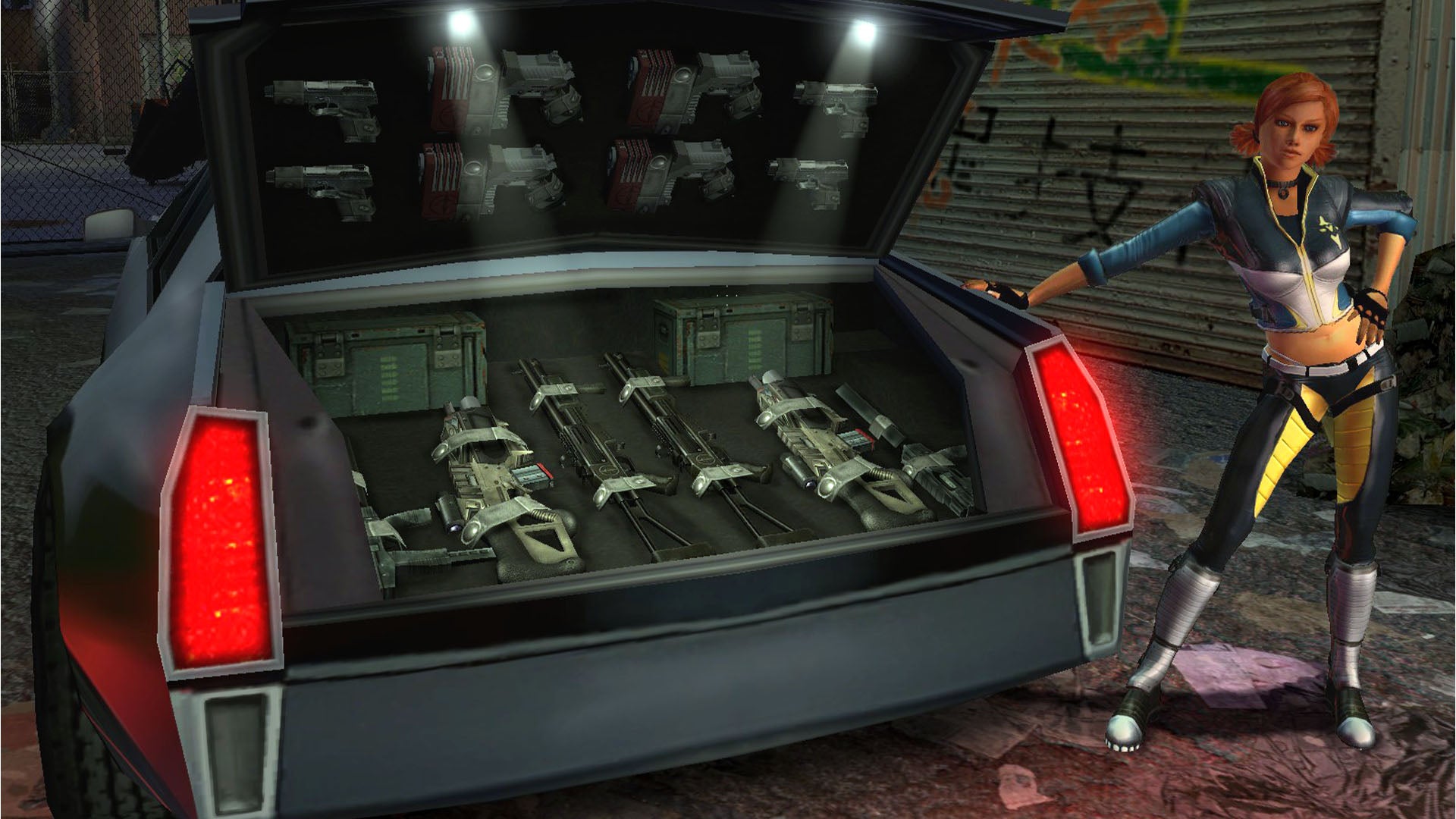
“We just faked the shit out of all these screenshots,” Atkins explains. “I would literally have concept art or a thumbnail open and I’d be saying to the team: this is how the shot should look. I want to have a grunt in the foreground or a cool district, you know. All of the team, we just jammed on this together.”
And so the cover of the August 2005 edition of PC Gamer featured returning hero John Blade and rookie sidekick Jessica Cannon. It hailed SiN Episodes as “Valve’s biggest secret”, and the “world’s first episodic game”. Even at this early stage, it was clear that the futuristic feel of the release model was as much a part of the product pitch as John Blade’s triumphant return.
Attribution
As production on the project began in earnest, there was genuine excitement within the studio about the possibilities of episodic development. For Emergence’s writer and lead game designer Shawn Ketcherside, an episodic structure opened up a raft of narrative and gameplay possibilities. “We had roughed out three sets of trilogies,” Ketcherside tells me. “And it seemed really interesting at the time, especially from a narrative standpoint, because one of the big things we wanted to do was be able to react to fan feedback.”
The idea here was that after each episode, the team at Ritual would be able to use player telemetry (implemented in order to facilitate Emergence’s adaptive difficulty system) to get a sense of which characters, story beats, and environments were resonating most strongly with players. “While we had an overarching story, there were elements of it that could have been adapted depending on what players were really gravitating towards,” Ketcherside explains.
As one of Ritual’s co-founders, Atkins perhaps had a more prosaic view of the virtues of the episodic model. “We didn’t want to get stuck in a long dev cycle,” he tells me. “We thought that Ritual had enough money in the bank at the time to self-fund the development of a short run project. To get an episode out.” In other words, work on Emergence could only proceed for so long before Ritual’s coffers would run dry.
SiN Episodes: Emergence launched to a positive critical reception that was undercut only by gentle disappointment at the realities of episodic delivery. The 2-4 hour runtime came in for criticism, as did the lack of variety in terms of the game’s arsenal and roster of enemies. But playing it in 2026, I’m struck in some ways by how solidly Half-Life 2-esque the combat encounters feel, and there’s a smattering of Havoc physics puzzles that bring you right back to City 17. In some ways it remains very playable 20 years on, which is an achievement.

In the weeks following Emergence’s launch, Ritual published updates and blog posts hinting at what might be in store for Episode 2. But by this point, Ritual’s leadership had come to the realisation that the series was unlikely to continue. Quite simply, Atkins says, the project “ran out of money”.
In Gabe Newell’s statement for Emergence’s launch, he claimed that an episodic release allowed Ritual to “achieve something every independent developer desires: The ability to produce a strong product on its own terms, own the property and realize the majority of the profits collected on the studio’s work.” Though, the reality of Ritual’s situation was murkier. Atkins claims that the actual deal that Valve had “driven” with Ritual was not an especially favourable one. “It was 50% going to EA [as the retail distribution partner], and then the other 50% was split between Ritual and Valve.” Atkins tells me. “So 25% to Valve, 25% to Ritual, and 50% to EA. I do not think that was a good deal. And I was pissed off about that deal.”
When Atkins realised they couldn’t afford to make a second episode he “disconnected” from the development meetings. “I couldn’t sit there and pretend,” Atkins tells me. “That part sucked because I knew that we were very close to beginning production. You know, I hate fucking with people’s time.”
The studio’s founders had hoped that once Emergence was available, they’d quickly begin recouping the development costs that they had funded, and that subsequent episodes would be cheaper to produce.”The issue we had was that we weren’t recouping fast enough,” Atkins says. “And we had ended up with a bigger studio than the episodic model could support. So we started having some internal conversations about how to fix that. And then that created tension between the founders of the company.”
In our conversations, Atkins more than once expresses concern about coming across as ‘negative’. But remaining upbeat is clearly challenging when somebody keeps asking you about the time you had to sell a business you co-founded and then abandon development of a project that you’re clearly very passionate about. I think it would be fair to say, though, that relaying this chapter in the history of his career seems to bring up some strong emotions for Atkins.

“I could see it,” Atkins says. “It was like a train coming. If we don’t get more capital flowing through the studio, it’s just going to implode.” This sense of impending disaster led to a great deal more ‘tension’ within the leadership of Ritual, Atkins says. He and Ritual co-founder Richard Gray decided to suspend the project and sell the company.
This pivotal decision – to sell the company to casual gaming outfit Mumbo Jumbo – clearly still nags at Atkins. “Looking back, it was probably not the right decision. We probably should have just pared down really small and kept doing SiN Episodes. But all of the pressure and tension and financial stress of that moment was… it just felt like going and making casual games and doing something with smaller dev cycles would be a reprieve from all of the stress that had been building over 10 years. And so it was probably a selfish, personal reason, more than anything that I made.”
He tells me that he talked to the Ritual team about accepting the acquisition offer and claims that “more than half” wanted to make casual games as part of Mumbo Jumbo. “I was so burnt out with all the stuff that had happened,” Atkins says. “I guess the Mumbo Jumbo life raft sort of felt, like, fuck it, you know? I’m going to jump on that, instead of the other route of trying to just keep Ritual floating.”

Some fans speculated that more SiN Episodes might appear once the ink was dry on the acquisition, but most recognised that the series was finished. The Ritual Entertainment that was known for its work on SiN, Counter Strike: Condition Zero, and Heavy Metal: F.A.K.K. 2 was effectively no more. But some parts of the studio survived in an unlikely form – the Source engine. Atkins tells me that Valve owned any of the additions Ritual made to the engine, with the most notable being their dynamic difficulty system. This, Atkins says, “was later leveraged by Turtle Rock around Left 4 Dead“.
And Emergence will always have a place in the history of episodic gaming. Okay, so it wasn’t technically the first (Telltale beat SiN to the punch with their Bone series, and that’s before you get into any arguments about whether Satellaview, Kroz, or Kuma Gameisodes count as episodic gaming) but it was pioneering nevertheless. As Ketcherside puts it: “I’m proud that we tried something different and new. I’m proud of the team and I’m actually so fond of Ritual for having the guts to try that.”
As we continue to talk, I wonder aloud whether it might have been bittersweet for him, to see episodic projects like The Walking Dead, Life Is Strange, and Dispatch find such success with the model. “As strange as it may sound, no. Because making games is hard, it’s so hard,” he says.
“I celebrate anyone’s victory and anyone’s success. I’m so happy for them. If they were able to glean anything from what we did, that’s great. It’s just such a challenge that I’m happy anytime anyone finds success.”


