Will: Follow the Light is a cracking videogame name. Especially when it fades in after a few trailer shots of first-person striding across frozen wastelands and carving a wave-battered yacht through stormy seas. The mystery and peril of some unknown journey, pierced by a beam of hope and determination, all conveyed in four words and a colon.
Then you play the thing, and it’s mainly about a Norwegian bloke doing DIY in sheds. Will is just his name. Øh nø.
In the interests of reviewing the game that actually exists, not just the one in my head, Follow the Light does occasionally take the shape of a bracing Nordic adventure. Will, a grieving lighthouse keeper, sets off seawards to track down his son and dad after they both disappear during a mudslide: a long and isolating trek across oceans and glaciers, with plenty of stops for soul-searching and puzzle-solving. In a Firewatch fashion, these puzzles mostly aim for grounded, naturally diagetic labours, maintaining the Will’s-own-eyes perspective for almost his entire voyage.
Within a couple of hours, sadly, it starts feeling like more of a busy Saturday of household chores – even if your house does have some lovely coastal views. Partly, this is thanks to Will’s fatherly plight being quickly stripped of urgency. Minutes after arriving in the stricken town, it’s established that the missing son is simply in the care of Will’s dad – a bit of a bum to Will himself, though by all accounts an able and loving grandparent – and that they’ve just… gone to his house? Even if it’s on a neighbouring island, Will lad, that’s not a rescue mission. That’s picking your kid up from the babysitter, and hardly justification for the multiple life-risking exploits that follow.
Attribution
The strangeness of this setup is at least mildly balanced by a parallel plot around Will’s internal toils. Which, in fairness, is handled more compellingly, even with some underdeveloped dips into the surreal. But still, the prospect of a family reunion never convinces as a suitable driving force for the game’s remaining six hours. It’s a compromise, an attempt to spin just enough worry to get you sailing into the fog but not so much that you can’t stop to listen to some audio logs and repeatedly undertake electrical maintenance work.
These puzzles are the other reason why Follow the Light starts dragging. The vast majority fall into two categories: menial tasks completed by trial and error, or menial tasks where an obvious solution is gated behind a succession of other, smaller menial tasks. The former extends to such tediously mundane jobs as placing identical-looking pieces of glass back into a smashed lamp lens, and the latter… alright, put it this way. Early on, you’re asked to get a spark plug off a shelf. I’m going to be vague here so as to not ‘spoil’ the ‘solution’, but it goes something this:
- Try the warehouse hoist controls
- Check a fuse box
- Find a fuse
- Replace the fuse
- Play the same fuse flip minigame you did 30 minutes ago
- Talk to a mechanic
- Walk outside
- Play another minigame
- Walk back
- Play the same fuse flip minigame you did in step 5, and also now 35 minutes ago
- Use the hoist
- Retrieve the spark plug
Twelve steps! To get a spark plug off a shelf! The queues at Norwegian B&Qs must be awful.

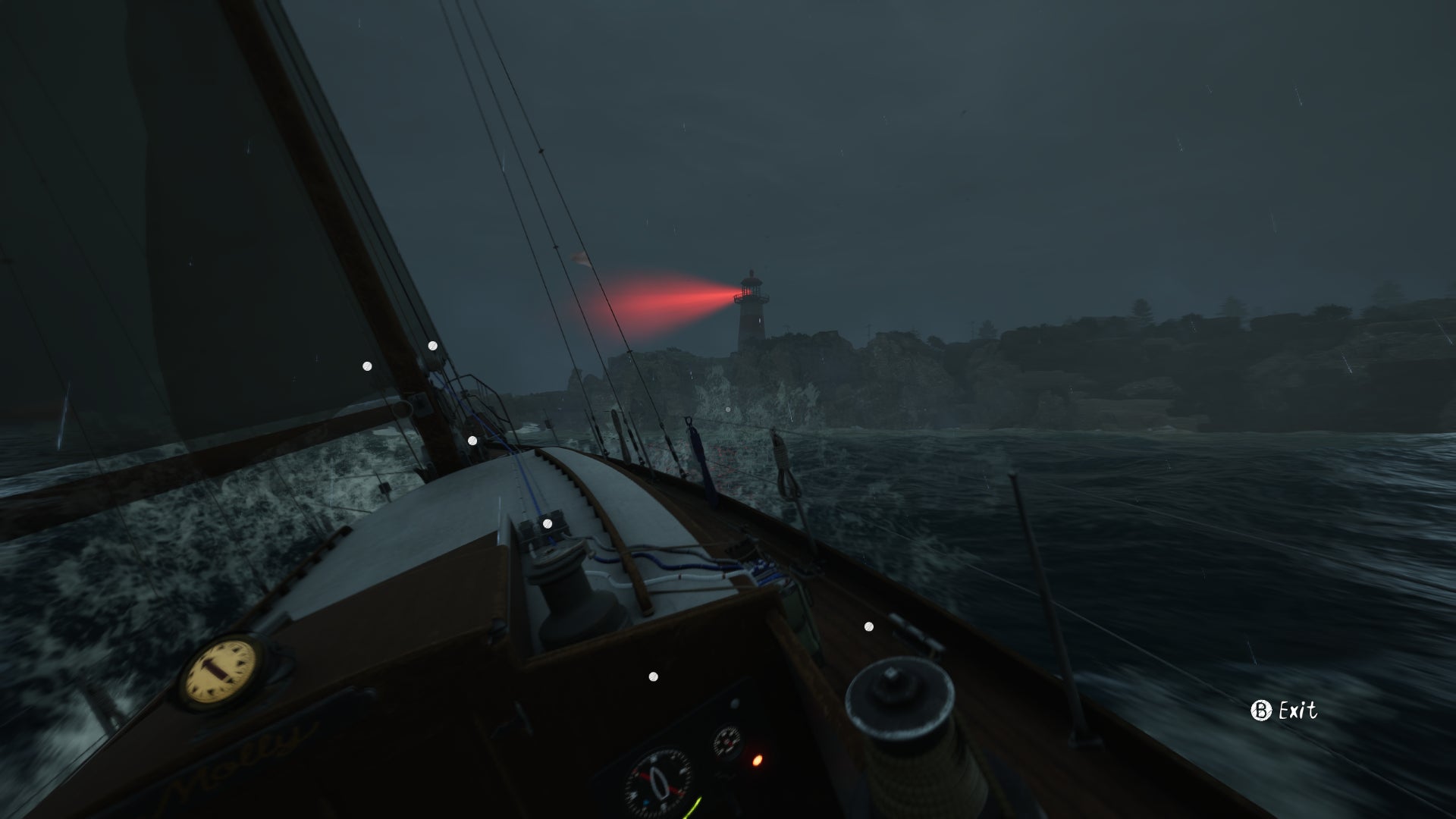
I particularly resent this kind of puzzle format because it stretches out the proportion of time that Will spends in beige offices and grey huts, or traipsing between them, when all of Follow the Light’s best bits take place out in the wilderness. Sailing, for instance, is a genuine pleasure. Your craft is rife with pleasantly tactile ropes and pulleys, and while I’m not Bristolian enough to hold forth on technical accuracy, TomorrowHead Studio have successfully built a tub that skirts the waves with a tangible sense of weight and shifting heft. The moments where you’re riding the wind away from another batch of land-based puzzle bores, sitting back to appreciate the sight of the horizon and the sound of varnished wood slicing through saltwater, could have made a respectable no-walking walking sim by themselves.
Even back on terra firma, taking Will further away from civilisation tends to make his game better. There’s an enjoyable, if somewhat indulgent dog sled ride through some mountains, and despite the ennui-inducing handyman duties not entirely sodding off, the subsequent Arctic venturing does show Follow the Light at both its most contemplative and its most visually arresting. Environmental art standards are high throughout, in fact, and I’ll concede that the interiors – as often as they herald another bad puzzle – are carefully lit and often heavily furnished with signs of their previous occupants: discarded tools, stacks of research papers and such.

It’s a shame that the rest of Follow the Light isn’t so smartly detailed. There may be a dash of Firewatch in its slow-paced rural traversal, but Will isn’t animated nearly as expressively as ol’ Big Hands Henry. Most of the time, unless you’re looking down at his legs, he’s barely animated at all. And with apologies to former STALKER dev Andrii Verpakhovskyi, Follow the Light regularly descends into Eurojank, only without the usual charm or depth. Its subtitles only sometimes match the dialogue. Its autosave points are baffling. It can bug out and refuse to accept you’ve completed an objective, leaving you stuck until you load an earlier save. Which, see point 2, might be just before a cutscene or mandatory tea-making vignette.
I did eventually power through to Follow the Light’s climax (also disappointing, for reasons relating but not specific to the aforementioned not-actually-missing child issue), and the only thing that could tempt me back is some kind of dedicated free-sail side mode. It’s frustrating: a game that’s so good in places at weaving that sensation of impetus, of literally moving forward with the wind at your back, also being so willing to bog you down in busywork. And I’d rather be dashed on the sharpest rocks in Scandinavia than have to poke at one more circuit breaker.


