Pragmata is the new third-person moonbase shooter from Capcom in which you play Hugh, a gruff spacedad, with a small girl android named Diana riding around on your back. The game’s core gimmick is that Diana can (and, indeed, must) hack the robots you’re battling to nix their shields and so forth, using a real-time holographic minigame in which you move around a grid to reach a green square. There are also simpler varieties of hack for opening doors and springing traps.
It’s a tactically faffy supporting puzzle element, with a heritage that extends all the way back to Gears Of War. Our guides writer Jeremy and deputy editor James have slightly conflicting feelings about Pragmata’s hacking, though they’re enthusiastic about Pragmata in general. Here’s a transcript of a woozy end-of-day videocall in which they politely bash those opinions against each other, with Edwin playing referee.
Edwin: Jeremy – you were saying in our morning meeting that you’re enjoying Pragmata but finding the split between the hacks and the action a bit of a chore. I couldn’t quite work out whether you actively disliked the hacking. Please, give me closure!
Jeremy: I’m going to say the hacking overall is a good mechanic. I’m glad it exists in the game. I think I wish the game did not fall back on throwing you into rooms with enemies all the time, and just making you hack loads of them in a row. The hacking kind of evolves to a certain point, and then it doesn’t evolve further. You’re always going to be playing that game of Snake and solving a grid throughout the end of the game.
You get mods to switch it up, but it didn’t really have enough different layers for me, and so I started to feel like it was maybe a little bit tedious halfway through. I’m not sure exactly how they might change that – it’s the first implementation of the system, so I can see how they might evolve it with a sequel, but that’s kind of how I felt.
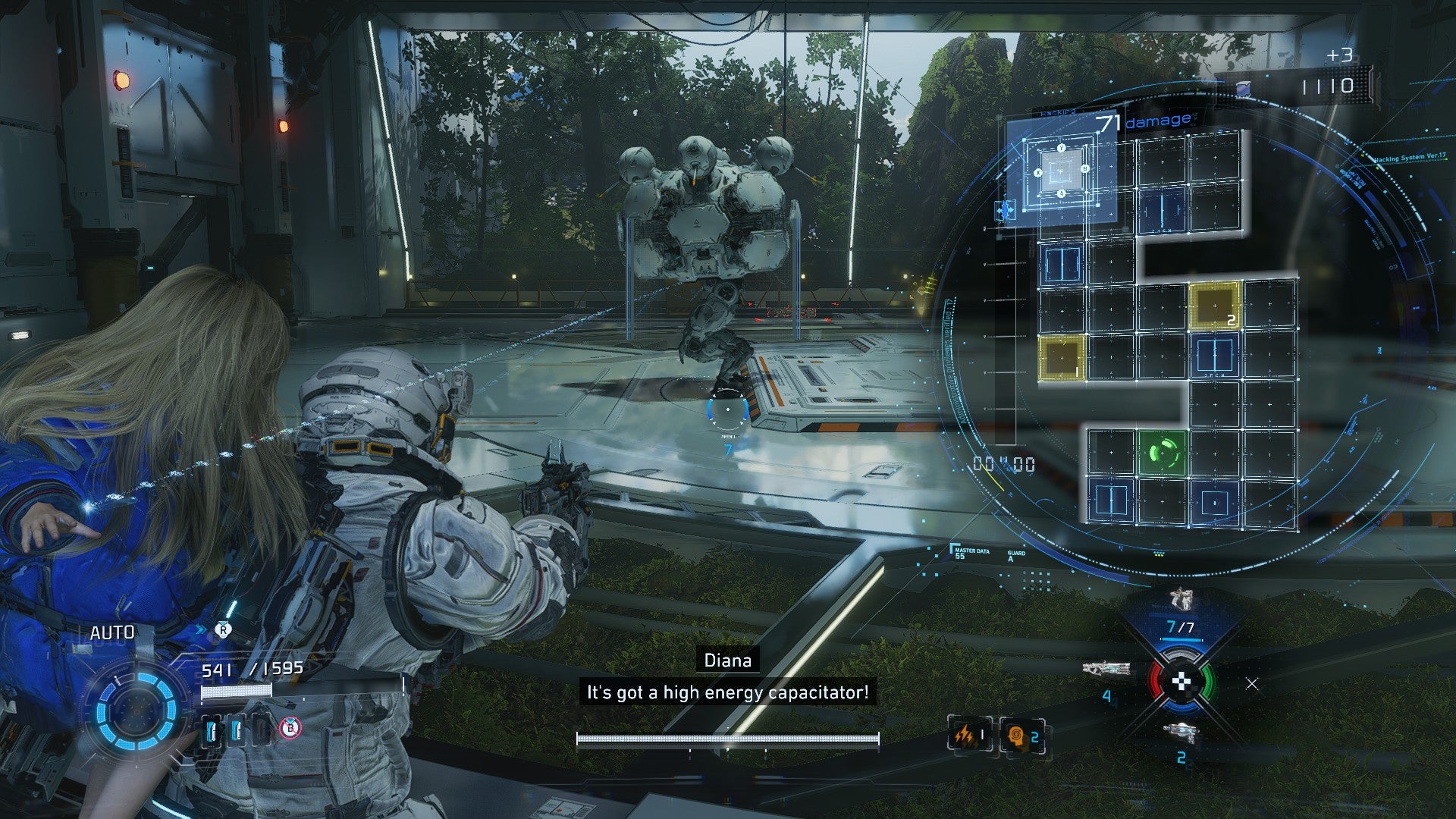
The levels are very dense. They’re very sprawling. I’m reminded of old Rare games, like Donkey Kong 64, because you run around and collect things – that’s the main draw of it, running around and collecting items throughout the level. And the in-game map is useless. I’ve never really played a game before that had an in-game map, and there’s a marker on it that says ‘here’, but that’s not where your character is. It just designates which sector of the map that you’re in. It’s designed to not actually reveal where you are on the map, to encourage exploration and collecting things.
And me, personally, I tend to find games where you run around and collect doodads exhausting, and I have since Super Mario 64. So I think that, combined with the constant hacking, and the lack of a map, and the fact that the hacking never really evolves to a level that kept me interested, I think ended up making me feel like, OK, great game, but I’m happy just playing it for an hour. I get exhausted playing it for longer than that.
James: Well, first off, I played for six hours without realising there was a map. So it can’t be that ruinous! I’m pro hacking in this instance. I think almost all of the tension in the combat comes from the feeling of having these robots bearing down on you, whilst you’re trying to do electrical engineering. If you take that away, you can imagine it being a very strange, probably quite bad shooter where the enemies just move very slowly.
Jeremy: Yeah, I don’t think it should be taken away!
James: [The slow enemies] are like affordances, to let you have a chance of doing the hacking. But the tension comes from this edge of wanting but not being able to shoot the robots, and having to close that gap as quickly as you can, via effective hacking. But yeah, I don’t know about finding it exhausting. Maybe, it’s just that the individual hack can be over so quickly, especially if you’re using a mouse, but I maybe don’t find it that fatiguing. I’m not saying ‘oh no, it’s this great thing and you’re wrong, Jeremy.’ I can understand why someone might find it fatiguing – I personally don’t.

OK, let me go a bit more strongly in Pragmata’s defence. I do think there is a fair amount of… maybe ‘expression’ is too strong a word, or ‘self-expression’, but I do think there’s a decent level of customisation in terms of how you can approach or how you can wield hacking. One way you can spec into it is to just absolutely speed up the process. Some mods let you you shrink the grid so you don’t have to move as far, and there’s that autohack module where you can spend some of your ultimate meter, to just have Diana do it for you.
So that’s one approach. I very consciously rejected that in favour of a different approach, which is speccing myself and the hacking minigame to instead focus on maximum damage. So I knowingly do slightly longer hacks, in order to make the robots die faster once the hacking is complete. So I think it’s not just like a button-bashing minigame. It is to a degree a platform for choosing your approach and maybe even expressing yourself a little bit. I guess that’s also again why I haven’t found it that fatiguing, because I’ve maybe trying out different things, or sticking with one approach I really like.
Jeremy: Yeah, I have tried out different mods. I was running a build that was focused on the freeze mod and the heat mod, and then I did some other things with damage, and you’re absolutely right, there are options there. I guess it might just be a ‘me’ thing. It wasn’t quite enough for me to stay engaged for 30 hours. And it’s hard for me to vocalise why – it’s a good game. I agree with you. But for some reason, it did just exhaust me a little bit.

James: What if we had more opportunities to hack things other than robots? I think one thing that maybe is underdeveloped is there are certain traps we can hack, using a slightly different minigame, and if a robot is in a particular spot it’ll kill the robot. And that’s nice but yeah, that could maybe be developed a bit more.
Jeremy: There are some environmental puzzles, where you hack things to push them, and they’re basically block-pushing puzzles. Those are fine, I would have liked maybe a few more of those. I would have appreciated if you had the chance to hack, I don’t know, mechs or something, and actually use them in the environment. You can redirect missiles back at enemies, and I thought that was very cool. I wanted to see more of, like, turning enemies against each other. Or more things that didn’t just boil down to: how can I kill the robots the quickest?
I guess more creative usages of the hack for me would be can I hack a robot and have it follow me for a little bit, throw it against enemies or something like that, are there ways to hack the environment that are not just block-pushing puzzles, at the end of the day, or opening this door to get more stuff.
The level design is not bad, but it felt a bit antiquated for me, in that you mainly use the hacking to open doors or hack a series of circuits in order to get to the next place, or hack a platform so that you can jump on top of it to get to a thing you need to collect. I think maybe a bit more of that would have been cool to see. The New York level where they do a Times Square thing, and it all looks like it’s 3D-printed and an expression of what generative AI might look like, if it was used to print things in the real world – I did like that. That was kind of the best level to me because it felt like the environment was a bit more interactable, but I guess that might have just been the visuals carrying the load there.

Edwin: One thing I wanted to ask was the hacking versus the shooting – I mean, it’s a characterisation thing as well, isn’t it? Because it’s split between your old fusty space dad and the weirdly Goldilocks-ish girl on your back, who’s the one doing the hacking. I don’t get the sense that made much of an impression on either of you. You weren’t, like, ‘personifying’ each mechanic, as you were moving between them. You were just thinking ‘this is effectively a gun with some interesting/annoying/tiring hacker elements, and I’m kind of having to hack the gun while I’m shooting it’. I don’t know if that makes sense?
James: Again, I didn’t find it annoying. There was like a brief moment when I was like, ‘hey, it’s kind of weird, I’m playing two people at once’. One other thing again, which I liked in the sense I would like to see more of it, was that there are some moments where you as the gruff white dude get knocked down or grabbed, and Diana gets knocked away. And in those moments you are only playing Diana, and you have to do an extended, almost Quick Time Event hack to fuck the robot and save yourself. Which is a cool moment of you are saving yourself, whilst you are technically having a sort of out-of-body experience. But I guess, moment to moment, there’s less of a sense of one person doing the shooting, and one little robot girl is doing the hacking. It’s just kind of mushed.
Jeremy: That’s to the game’s credit, in a way, because it’s a very good way of controlling two separate characters in a game – probably the best I’ve seen. But I’ll say this, I think James is absolutely right in saying that hacking is critical for the game. Without it, it would probably be a pretty mediocre space shooter.

Hugh’s manner of play, if we’re going to separate it by characters, is not that compelling. He’s a guy in a space suit, and he jumps and has thrusters and he shoots things. The hacking is definitely more interesting. For me, I think I would have liked to see just a little bit more from the hacking in terms of creatively hacking environments. Not so much less hacking, but more creative uses of hacking that weren’t necessarily for combat. That might have elevated the experience just a little bit higher for me, and made me think, this is Diana’s thing, she’s hacking and Hugh is the one that shoots – two different styles cohesively merge into one.
James: All I heard there was “James is absolutely right”. End article.
Jeremy: Yeah, it’s tricky for me, I don’t disagree with James and I feel like everyone in the comments is gonna be like, ‘oh, Jeremy what are you talking about?’ I want to stress that I like the game, I do like the game.
Edwin: The other thing I’ve been thinking about is how this fits into the lexicon of games with more complicated supporting or alt mechanics. I’ve read some reviews of Pragmata that praise it for being an absolute original, which I think is a bit – maybe it’s just that they were written by younger writers, and I’m a miserable old fart, but I think of Pragmata’s hacking as an extension of Gears of War’s active reloads. They had different bars and timings for each weapon, and obviously it’s not the same as a full-on hacker interface, but it’s the same broad idea of shooting things and dividing your attention between that and a little bar with a reflex element.
And it made me think about that sliding scale of fun into irritability with these commercial games, where if there’s too much of a clash between those parts of the game, it very easily becomes obnoxious for some players, and it must be quite a hard thing to design. And so I wondered if there were any comparisons you wanted to draw in terms of other games that have the same hybrid approach, and do it better or worse?
Jeremy: For me, it comes back to a comparison that somebody at IGN made, which is The World Ends With You for Nintendo DS, which is a very good, technically impressive and stylish RPG that has a complicated combat system where you use both screens, and you control multiple characters on different screens, and so it’s quite macro-oriented.

There’s a lot going on and for me, that was another one where I was like – it’s a great game, but I get exhausted playing it. So, it could just be that these sorts of games are a little bit more than what I want to play for extended periods of time. It’s obviously different for everyone because I can spend hours banging my head against a Soulslike boss, apparently, while other people will give up. And for some reason, I’m okay with the ‘keep trying until you prevail’ sort of thing, but I’m less good at monitoring lots of information going on at once, and maximising this combat encounter or this hack.
Edwin: It’s interesting with Soulslikes – there are highly skilled Souls players who do that thing where they access the inventory in the middle of a duel or a bossfight, and make some rapid changes to their loadout to switch into a whole different playstyle. And they memorise the inputs so that they can do it without looking, which I guess is like a player-engineered version of Pragmata’s hacking, because obviously it has to happen in real time.
Jeremy: Yeah, I don’t do that. I just keep banging my head against the boss until they die. I’m very much trial by fire, just keep on doing it, addicted to pain and suffering.
Edwin: Well, you are a guides writer. The other one I think of is Okami, where you’re a… high-kicking? Or maybe roundhouse-kicking wolf. Probably high-kicking as well, I can’t remember the Okami moveset. And then you can switch on painting mode and paint a bunch of trees or sorcery effects, or whatever. And it at least pauses it, but that game also has controller-based drawing mechanics, which are always a bit of an ordeal, so even though it’s paused, it’s still a faff for me, and it compares a bit to Pragmata.

OK then. Anybody have any closing thoughts? Sorry, I should have formalised this more.
James: James is absolutely right.
Jeremy: James is absolutely right but I throw my own bullshit in there, ever so slightly.
James: Nah, I’m absolutely going to go away now and try to think of other examples where I like something, but I don’t want to do it anymore, because I think that’s an interesting concept.
Jeremy: Yeah, it’s hard to think of in the moment, but they definitely exist and Pragmata is just one of them for me. I would recommend the game to anyone, and I’ll say that this is probably just my experience, but I need to psychoanalyze myself deeper, and figure out why I feel this way! A lot of it probably has to do with the reality that my brain’s not very good with pattern recognition or puzzle games. Maybe the fact that you have to solve a little puzzle, maybe my brain gets exhausted at that.
I am good at rhythm games. I dare say that if Pragmata had had some sort of rhythm-based thing in there, like to music, I would have loved it. The only puzzle game I’ve ever really loved is Lumines for the PSP – it’s also available on Steam. I love that game because it’s set to music and there’s a rhythm in there. My sense of logic in general and block-pushing puzzles, shifting patterns, is pretty bad but my sense of rhythm is good. So it could just be a brain thing and maybe Pragmata taps into a certain type of brain.


