Ed (RPS in peace) has, finally, posthumously, got his wish: another Screamer. This one’s gone all cyberpunk and/or anime-styled, with a heavy focus on story – it follows multiple, multinational merc-drivers entering a lightly murderous racing tournament – but can it still deliver on drifty driving thrills? After much practice, Mark and James both avoided clattering into the track barriers long enough to find out.
James: Mark, I might need to lean on you for accurate automotive lingo here – my notes on Screamer’s car handling are hastily scribbled nonsense like “scampery” and “easy to get the arse out.” I can advocate later for the practice of always going near-perpendicular through every slight bend, but as our resident expert, how do you find Screamer as a straight-up racing game?
Mark: At first, I was fairly convinced that Screamer’s controls and I weren’t going to get on. The crux of my issue was how the ability to drift is tied to flicking out the controller’s right stick in corners, independently of the steering you’re doing with the left stick, or how much throttle/brake you’re applying at any given time. As a result, the sliding that’s key to getting around Screamer’s twisty tracks quickly feels detached from the typical driving inputs every racing game has, which certainly takes a bit of getting used to.
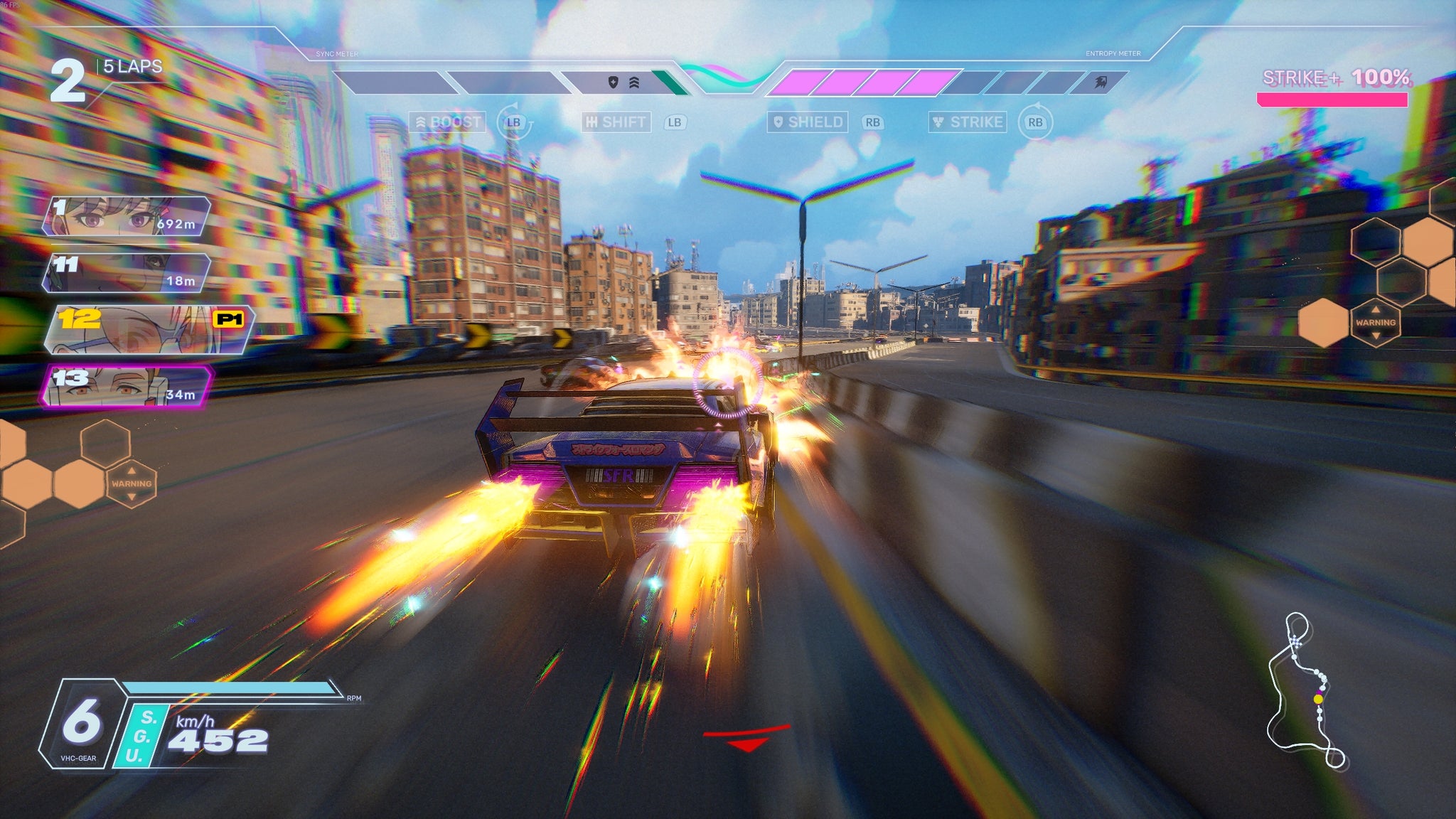
Once I got into the rhythm of it, though, I found it no barrier to slicing around courses feeling as satisfying as it should in any boost-happy arcade racer. My feelings were a bit more mixed when it comes to how unforgiving Screamer’s walls can be. As someone trained by the likes of Burnout and Need For Speed that the occasional bounce off the scenery is a often a perfectly fine substitute for actually using the brakes (provided you don’t hit hard enough to totally wreck your car), learning to stay off the guardrails as much as possible – in order to avoid having my speed halved – has been tough.
James: I love the twin-stick setup, in all honesty – get to grips and it’s essentially the power to fine-tune how you attack tricky corners, but there are also loads of long, loping turns that let you keep the back wheels pushed all the way out while just utterly flooring it for the full duration of the bend. That, to me, is arcade drifting heaven, of a gleefully exaggerated kind that I haven’t really enjoyed since those Burnouts. There’s enough weight and engine growl, too, that slipping around like this doesn’t feel too floaty or airy.

It’s definitely super-punishing of muckups, though. Besides eating your KP/H, it’s harsh that bumping the sides also costs Sync – the gradually earned technobullshit gauge that powers boosts and, by extension, the ramming ability that forms the backbone of Screamer’s vehicular combat. I like the resource management aspect in theory, as it adds a degree of tactical thinking to what might have otherwise been a simplistic, almost instinct-based racer, but is it not a bit strange to make the breakneck thrashing-about so appealing, only to then encourage the more clinical, careful style you need to maintain Sync buildup? I struggled with that disconnect a lot on some of the tougher story races.
Mark: Speaking of the tougher story races, there are plenty I’ve had to try multiple times on my way through. Typically it’s been ones that require successfully hitting certain opponents with knockout attacks – which see your car lunge towards them for a fatal swerve, powered-up by a meter which charges as you boost – and also demand you finish above a certain position. At the start of each race, it typically takes at least half a lap or so for your boost and attack meters to charge up so you can start using them. That’s fine on its own, but in this context it stops you from trying to rack up knockouts early doors when the field of foes is most tightly packed together.

As the laps tick by, big gaps tend to form between runners, so if you’ve got to knock out someone who’s running in a lowly position and still make it back to second or third by the end of, say, lap three, the timing can end up having to be near-perfect. The most effective way to catch up to opponents who’re streaking ahead – a super-boost mode dubbed overdrive which essentially turns you into an uber-fast wrecking ball – is just as merciless. At first, it makes you invulnerable as it speeds you up to mach 10, which is perfectly hunky dory, but then it makes you so brittle that one wall hit will blow you up. Needless to say, I’ve exploded many times. While that’s carrot and stick, the individual drivers’ unique abilities I’ve found to be usually one or the other. Main character Hiroshi Jackson’s got some wonderfully overpowered double boosting, while his mate Frederic has to make do with more volatile attacks that are just as likely to blow him up as any opponent.
In a lesser game, the regular demand for near masterful precision just to earn a passing grade might have dulled my enthusiasm to keep collecting chequered flags, but I’m glad to report that’s not been the case here. I’d honestly not paid much mind to Screamer’s anime-inspired visual style or its story before diving in, but have been pleasantly surprised how much both have grabbed me. The car designs are particularly cool, taking design cues from real world rides and slotting them into long, wide bodykits that remind me of fire-spitting silhouette racers. The fact I found the narrative surrounding the drivers of these machines equally as engaging is even more of an achievement, given how close a lot of racing game tales typically fly to the sun of cringe.

James: It’s funny to revisit the reveal of Screamer’s new look, and see reactions varying from unbothered to repulsed. Anime fits this game like a fully tightened wheel nut: its noisy excess, its love of bold colours, its episodic jumping between track locales, its enormous cast of emotionally compromised weirdos, it all could have come from the pen of a starving mangaka in Hiroshima. It just happens to have come from a bunch of bike sim devs in Milan.
I, too, enjoy the company of these weirdos, and admire how efficiently Screamer got me following their respective pursuits. Which can’t have been easy, given there’s over a dozen of ’em. There’s a revenge plot that gives equal time and weight to its target, a sympathetic ex-Yakuza type struggling with PTSD, multiple (yet usually rather sweet) romantic subplots, and even the six-packed, floral-shirted mechanic (who’s figured out to how converse with his dog) gets some decent material as the conflicted inventor of the tournament’s driver-reviving tech. It’s daft, but good-daft, delivered through charming VN-style interludes and tightly directed animations.

Mending these hearts and powersliding through these mysteries is part of why I’ve kept playing, in spite of sometimes smashing headlong into the same difficulty spikes that you’ve endured, Mark. Though deep down, I’m also in it just for the speed. The speeeeeeeeed. No, my boost timings are not optimised, and I miss most of my charge attacks, but that central, core sense of velocity is just delicious, and the readiness with which Screamer lets you hurl yourself doors-first around every corner makes it so hard to begrudge it for the occasional balance mishap. It really is easy, on all cars, to get the arse out.
Mark: It’d have been very easy for Milestone to have shown their own drifty arse in trying to balance this many narrative plates, including a few characters whose boundless enthusiasm practically burns a hole in the screen. Instead, as you say, the quirky eccentricities are endearing, and the serious emotional beats have just enough weight to ground the the characters whose motivations are a tad more complex. I also feel like I’ve learned about 15 new languages just through listening to them all chat in their native tongues. Having played through to the end of the main story, I would say that some of the conclusions to Screamer’s narrative arcs perhaps feel a little bit rushed, or not quite as satisfying as their lengthy buildups suggest they’ll be. That’s nitpicking though, and something I might soften on once I’ve had a bit more time to think about the final chapter I’ve just blazed through at a fairly breakneck pace.

I also want to spend some more time with Screamer’s non-story online and offline modes. While I’ve had a bit of a play around in the garage, mainly to check out some of the alternate car liveries I’ve unlocked playing through the tournament, I’m keen to see if there’s enough to that customisation (and the likes of the score challenges) to keep the game feeling fresh long after you’ve seen the back of its tale of racing revenge and ruses. To be honest, though, that’d be a flashy paintjob on top of a motor which I’m already confident in saying offers a thoroughly enjoyable thrill ride that’s well worth the time of any arcade racing veteran – or newbie open to learning the intricacies of left stick drift.
If that’s not too sales pitchy already, I’ll end with this: I can confirm that during at least one race, you get the opportunity to drive around as a dog in sunglasses.
James: Wow, spoilers, Mark. I would’ve loved the surprise of driving in sunglasses.


