Ironically, considering the rampant dysentery moving through my campground in brown, sputtering waves, the problem I’m facing in Transport Fever 3 is a blockage. The trucks I’ve loaded with antibiotics are stuck in a traffic jam that stretches all the way to the pharmacy in the next city over. If I’m to save the inaugural Woodstock festival, I must find a way to get traffic flowing again before the timer runs out.
As with previous Transport Fever games, this logistics-focused citybuilder covers a wide span of history. You can start a sandbox game in 1900, building a network on the backs of horsedrawn carriages, steam trains, and paddle boats, and then play it through to the 21st century, replacing those carrot-eating horses with petrol-guzzling cars. You also replace the trains and boats with modern equivalents, but I don’t know if you would say that a train eats electricity, so best I don’t overextend the wordplay. And boats, who even knows what those buoyant bastards eat?
Instead of the sandbox, I dove into Transport Fever 3’s new campaign. This is a string of missions set at different moments in history. Rather than just building out a profitable transport network, you’re given set tasks – such as setting up the infrastructure for Woodstock’s stage and camping ground. Which is how I came to be in my current sticky predicament.
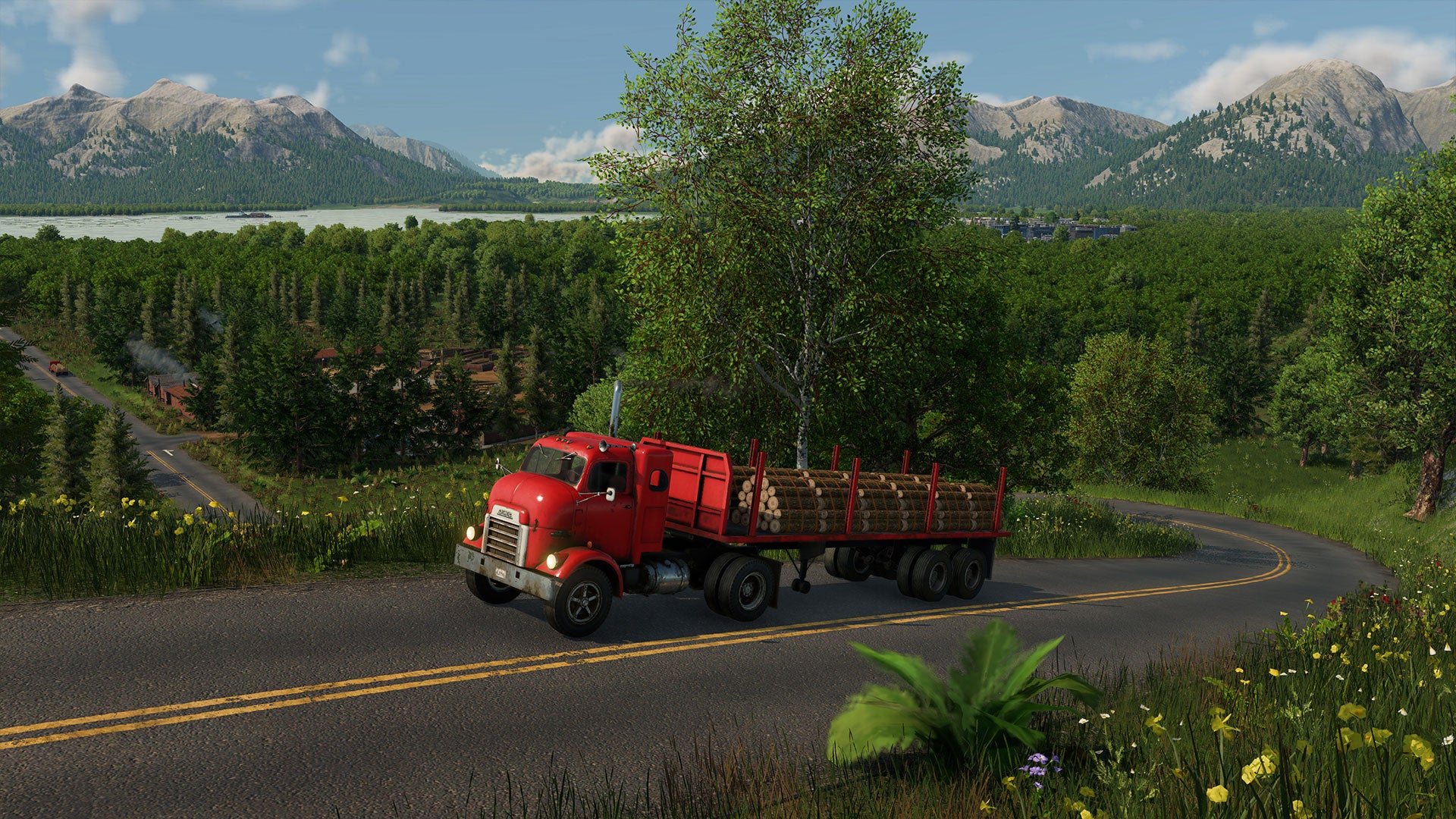
The job started simply enough. The stage builders needed planks to begin work, so I built a drop off point outside the festival grounds and connected it up to a nearby lumberyard. As in the previous games, you need to place a bus stop or depot for your vehicles to transport goods and passengers. When the vehicles deliver their haul to the dropoff, the resources dribble out to the building sites and shopowners in the nearby area. With the line connected up, I bought a few trucks at my vehicle depot and set them to work ferrying logs to the festival site.
More complicated than building the stage is the nearby campground of eager concertgoers. While technically a campsite, it will become more of a small city, with over 1000 people moving in for the festival. Those people may want to start a free love revolution, but they will need a lot of canned goods and vegetables to feed that passion. So, even though the starting camp was small, I built a large cargo depot that would allow multiple trucks to deliver their loads simultaneously. Nothing says swinging sixties like haulage logistics. Naively, I thought this would keep my goods deliveries flowing and the growing settlement well-stocked in canned beef and vegetables from the nearby towns.
This, I will learn, was my big mistake.

As in past Transport Fever games, you build the infrastructure but the city grows by itself. When an area is well-supplied, houses, businesses, and roads flower around your bus stops, tramlines, and goods delivery spots. While the depot began on the edge of the campsite, as goods poured into the settlement and businesses and residents made a home there, the depot went from being on the outskirts to slapbang in the centre. At first, the trucks would speed to the drop off, deposit their delivery, and hotfoot it back to the motorway to restock. Now they’re queuing up on streets thick with residents’ cars.
A sensible city planner would have built the main depot outside of the campsite’s limits and then dotted smaller dropoffs around the settlement. While the smaller trucks would still get snared up in traffic within the town center, the total volume of deliveries would have remained high. Alas, I am not a sensible city planner. Even with the pace of deliveries slowing, the campsite continued to grow through the sheer number of trucks I had serving the routes. Pigheadedness was winning out.
Then shit hit the fan. Or, rather, the river.

I was tasked with building toilet blocks around the campsite and, once they were brimming over, I was told to send my sewage trucks to empty the stinky cargo at a dump on the riverbank. Giving back to nature and all that. Not long after, the sheriff told me the camp’s residents were looking a little peaky. And by peaky, I mean making a mess all over the campground. Turns out the hippies liked to go swimming in that river and my dysentery chickens were coming home to roost. Just to be clear, these are all scripted story beats – Transport Fever 3 hasn’t embraced the full effluent simulation of Cities Skylines. The sheriff demanded I fix the problem. If I didn’t deliver enough antibiotics to the camp for all the sick residents before a timer ran out, the concert would be called off.
This is where the traffic in town really became a problem.I set up a line between the pharmacy and the depot in the centre of town, bought a fleet of new trucks, and sent them to go pick up the drugs. Despite only being a short journey, the vehicles struggled to leave the yard. The traffic was backed up all through town. Even once they had made the pick up, the vehicles immediately hit gridlock on the return journey.
As the timer counted down, I watched a line of trucks inch forward on a motorway stuffed with traffic. Back at the campsite, I tried to ease the congestion, building a bus route to encourage residents to take public transport instead. I built new roads to the motorway to offer more routes into town. I even deleted the traffic lights on all the crossings, hoping… well, I’m not sure what I was hoping for, but it didn’t help.
The timer ticked down to zero long before I got the necessary medicine into town. Woodstock was cancelled. The Free Love revolution would be delayed and it was all the fault of a gridlocked campsite and waterborne bacteria. Sorry, everyone.

On a second playthrough, I did manage to crack the puzzle. Though, it wasn’t through canny logistics: I basically just bought more trucks and made sure it was easier to access the depot. It was on that replay I realised I could probably have made use of the other toys in my box. While the farming village and textile town were connected to the campsite by large roads, there were also train stations and docks I could use to ferry the goods instead. I’ll leave that more holistic attempt for another time.
I wasn’t expecting to tell a story of dysentery when writing about Transport Fever 3 – and I’m very glad I am – but I don’t want to oversell my time. I didn’t see a great deal in this preview that differed greatly from the previous games, including some criticisms you could just as easily lay on its predecessor’s campaign.
It’s a shame that, for a game which aims to show you the sweep of transport history, the systems and their presentation often don’t match the story developers Urban Games are telling. For instance, the timer that appears when the campers contract dysentery. The sheriff frames it as a problem to solve in a matter of days, and it amounts to about 15 minutes of play time, but that equates to eight months on the in-game clock. Likewise, the character telling you you’ve three days to build the stage may sound urgent, but it took me more than a year of game time to complete it. While this is just a mismatch between the storytelling and the world, it’s one that detracts from the illusion.

Another example is the laughable disconnect between the money in your pocket and the time period you’re operating in. In the Woodstock mission, you start with $40m in your bank account. This is a level that’s set in 1969. To make that money make sense, the vehicles you’re buying are over $600,000, when in reality they sold for tens of thousands. This disparity stands out even more in missions set earlier in history, like the one in 1902 where you’re preparing New Orleans for the Mardi Gras festival. Again, you start with millions of dollars in the bank at a time where you could buy for $1 – checks Google – a toddler’s tricycle, seven-and-a-half pounds of steak, or nine bottles of cocaine toothache drops. Okay, none of those really help to illustrate the point, but it’s a slight frustration that in embracing these historical campaigns, Urban Games haven’t found a way to make the game’s economy or calendar match the setting and objectives they’re giving you.
What’s more of a problem than the disconnect between the game’s systems and its setting are the way in which success in the campaign missions live outside the rules of the sandbox game. As well as arriving with $40m in my pocket, by the time I won the Woodstock mission I was $10m in debt. I hadn’t made a profitable or functioning transport network, I had just thrown my vast starting sum at the problem until I overcame it.
I do love that a transport city builder wants to tell stories and not just rely on us making our own fun in a sandbox. But these are not new criticisms of Transport Fever and it’s a shame that Transport Fever 3 doesn’t seem to do anything to address them. That all said and done, I am going to replay that Woodstock mission and I am going to build a ferry line. And so help me, if that doesn’t help get the traffic jams unstuck, I’ll likely break out some grid paper and see if I can’t work out a more optimised road network to help alleviate the strain on the main thoroughfare.
Gosh, I’m fun.


