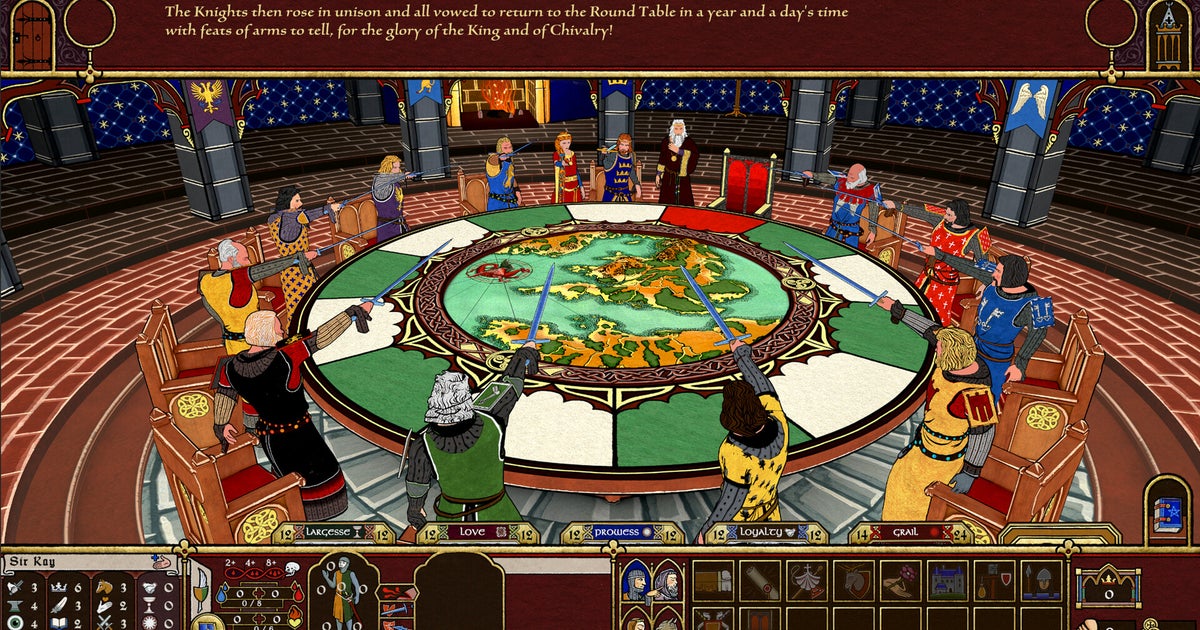
Legends of the Round Table isn’t just a turn-based RPG, it’s an extravagant 13th century puppetshow with live medieval lute music and a boisterous, singing narrator you can all but visualise prancing around the stage, splashing mead over the less important courtiers. It’s also a jousting experience in which you can juice up your charge with Love, one of the principle chivalric virtues, in order to clang a dude right off his horse.
I clanged that dude mainly because the maiden to whom he’d pledged loyalty was mean to her sister. She tore off the sleeves of her dress! This, truly, is an insult worthy of King Arthur‘s attention. Although I am not King Arthur yet, just Arthur the idiot squire, who lost his brother Kay’s sword on the morning of the big tournament. Away with thee, Arthur, you fopdoodle! Away into town, where there might be a stone you can yank a blade out of. Failing that, perhaps you can trade those fancy sleeves for a large kitchen knife at the tailors. Yes, this latter scenario is just my little joke. Although Legends of the Round Table does feature haggling mechanics.
I probably don’t need to tell you that Legends of the Round Table is a looker. It’s another in the surprisingly prosperous subgenre of games that resemble illuminated manuscripts, with 3D character models perched on a beautiful scroll of rich pigments that you just know the developers hand-recreated by boiling cabbages. Durst I compare it to Paper Mario? I was thinking it looks like the Bayeux Tapestry, but that’s the wrong century. It also has marginalia like nobody’s business. Look at that combat HUD – a little world of arched windows and gold foil. You’ve just about worked out what all the icons mean and then you get into a duel and the game springs some fantastic card designs on you, to boot.
Speaking of combat, this isn’t quite the usual business of moving units into flanking positions. I’m still getting my head around the systems, but it captures the ambience of men wearing a lot of cloth and metal banging into each other. Each individual clash sees you wagering points from your stats and cards. If you don’t have enough points to beat the enemy, you can also use inspiration to tactically lower your hit score and access cool parrying techniques. The latter appear on the spinny wheel in top right, which also indicates which body parts are being targeted. If you successfully clobber another knight you’ll drive them backwards, depleting their action points until they parry and turn the tables.
If you’re losing to another knight, you can beg for mercy to avoid death, losing Opulence points in proportion to your humiliation. If you’re the Knight inflicting the ass-kicking, you can withhold that mercy and lose some Honour. It is possible to be dishonourable by accident, because your Knight is too proud and contemptuous to muster the numbers for the associated skillcheck. Yes, there appears to be Much Ado, here.
What might turn you off is the omnipresent narrator, who speaks on behalf of characters. If you don’t like her spirit and whimsy, you may not savour the wealth of writing and dialogue choices. Obviously, you also need to be keen on Arthurian fantasy and our old buddy Geoffrey of Monmouth.
Chaser: there is an actual Round Table here, which naturally forms the heart of party management. “Choose those deserving of a seat at the Round Table, assign the most fitting Knights for each quest, oversee their occupations and witness their individual journeys of development, aging, conflicts and ultimately, their death,” explains the Steam page. I’m trying to remember whether I like Gawain more than Percival. Alas, all my own memories of King Arthur have been overwritten by Type-Moon. Is Gawain the one with a Reality Marble full of copycat swords? Does King Arthur ride a motorbike in this one?


