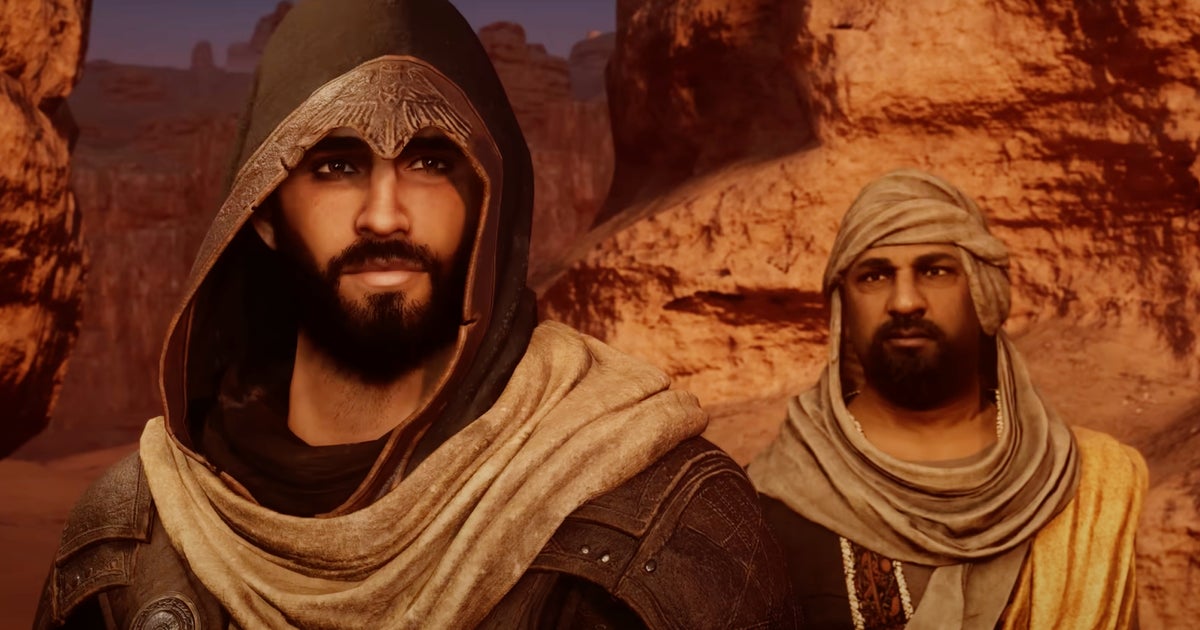
Assassin’s Creed Mirage‘s free Valley of Memory DLC, reportedly the product of a partnership between the publishers and the Saudi-backed Savvy Games Group, releases in November.
Announced back in August, the free DLC takes players to 9th century AlUla, an ancient oasis city and governorate in Saudi Arabia. Ubisoft’s announcement post didn’t mention the country by name.
In an official reveal today, Ubisoft revealed that the DLC will arrive on November 18. Valley of Memory’s new story chapter takes place just before the final story beats of the base game, with Basim looking for answers about his father. Both the base game and the DLC will see a bit of a parkour revamp, the ability to replay base game missions with fresh rewards, and three new difficulties – medium-plus, very hard and custom.
“When developing a game, we explore countless ideas and iterations for the setting in which the story takes place, the DLC’s creative director, Oliver Leonardi, said. “For Mirage, we ultimately chose 9th century Baghdad as the backdrop. But, from the start, we had other locations in mind for Basim’s journey.” So, Ubisoft say, this DLC’s about celebrating the game’s second birthday by bringing one of those old ideas to life.
The reveal saw Ubisoft discuss how AlUla’s been re-created in the game, with one of the talking heads being Dr Abdulrahman A Alsuhaibani, vice president of culture at the Royal Commission for AlUla. The Royal Commission for AlUla’s website‘s ‘our aspiration’ section notes that their “development work in AlUla encompasses a broad range of initiatives across archaeology, tourism, culture, education, and the arts, reflecting the ambitious commitment to cultivating tourism and leisure in Saudi Arabia, outlined in Vision 2030.” That’d be the Saudi state’s Vision 2030 project.
Ubisoft has declined to offer conclusive answers as to whether the free DLC has been funded by the Saudi government’s Public Investment Fund. Since news of the DLC broke, the company has faced criticism and questions over working with the country, both externally and reportedly from staff. According to an internal Ubisoft Q&A published by Game File’s Stephen Totilo last month, Ubisoft workers asked whether Ubisoft execs believed associating with the authoritarian Saudi state could have a negative effect on the company’s image earlier this year.
The worker specifically cited the killing of journalist Jamal Khashoggi in their question, which was allegedly carried out at the order of Saudi ruler Mohammed bin Salman. Khashoggi’s murder aside, Saudi Arabia have an abysmal human rights record, including state-sanctioned homophobia and mass killings of migrants at the country’s border with Yemen. The state has been accused of using investments in industries like games and sports to attempt to ‘wash’ this reputation, rendering itself more palatable in foreign eyes.
In that internal Q&A, Ubisoft, who have asserted that they’ve retained creative control over the DLC, attempted to make a distinction between the Saudi government’s Public Investment Fund and bin Salman – who is also the Public Investment Fund’s chairman. “The [PIF]’s money is not MBS’s, and talking with partners who do not share our democratic values does not mean abandoning them,” the company’s management said at the time.


