.trn-article__content h1 { margin-bottom: 29px; margin-top: 29px; font-size: 28px;
}
Resource management is a common element in many video games, and
Fortnite is no exception. Though Fortnite players have to manage several
different types of resources (think weapon ammo and health), when we
talk about Mat Economy, we are specifically interested in the management
of building materials.
The process of collecting materials (mats) isn’t particularly difficult
in itself, especially during early game, when players are generally
spread loosely throughout the map and focused on finding loot; on the
other hand, harvesting mats is fairly time consuming and becomes
increasingly challenging to do as the game goes on since:
- There are fewer mats to farm
- There are more enemies within attacking range
- Players need to focus their attention on other aspects of the game
Anyone who has played Fortnite knows how vulnerable you are without any
mats. This is especially true in high levels of competitive Fortnite,
which often sees upwards of 50 players remaining on the map during Zones
4 and 5. At this point in competitive matches, there are tons of players
within attacking distance who are more than happy to laser your health
away, so constant protection is crucial.
It is nearly impossible to collect mats this late in the game other than
through a refresh (eliminating a player and collecting his loot), and
the movement of future zones means that you can’t just camp inside a
single structure. This makes it all the more important that you collect
sufficient mats early and maintain enough throughout the game in
preparation of endgame/moving zones.
Though there are certain strategies that you can use to prolong
survival in the absence of mats during endgame, your prospects are
generally bleak; materials not only provide protection but also increase
the range of tactics that you can use.
Okay, so how important is Mat Economy really? Well, I collected
player Mat Economy data from the finals round of the NAE DreamHack Solo
tournament on October 15th, 2020; the data tracks each player’s number
of builds remaining at the start of each zone (when the storm begins to
move).
The basic question I wanted to answer with this data was, “If a player
has X number of builds remaining at the start of Zone Y, how does he
normally perform through the rest of the game?” I found that the
correlation between a player’s builds remaining and his final placement
in that game does vary depending on the zone, but there is an undeniable
correlation once you get past the early game zones.
Take, for example, Zone 4. If we separate all the players in each game
remaining at the start of Zone 4 by how many builds they have in their
inventories, we see a distinct trend related to their survival:
- Players w/ 50 builds or less: 50% of them survived to the start
of Zone 5 - Players w/ between 51 and 100 builds: 76% survived to the start
of Zone 5 - Players w/ more than 100 builds (max 150): 92.6% survived to the
start of Zone 5
And the trend isn’t just limited to short term survival; here’s how
those same players placed in their games overall:
- Players w/ 50 builds or less at start of Zone 4: Avg. placement =
~44th - Players w/ between 51 and 100 builds: Avg. placement = ~35th
- Players w/ more than 100 builds (max 150): Avg. placement =
~22nd
These are some pretty big differences in survival and they don’t
disappear at other points of the game; here are the same metrics for
Zone 6:
- Players w/ 50 builds or less at start of Zone 6: 42.1% survived
to Zone 7, avg. placement = ~26th - Players w/ between 51 and 100 builds: 72.4% survived to Zone 7,
avg. placement = ~19th - Players w/ more than 100 builds (max 150): 85.7% survived to
Zone 7, avg. placement = ~13th
Of course, there is variation that becomes more clear once you break out
of the bins above. But this is to be expected. Any game with as many
variables as Fortnite is certain to have a bunch of statistical noise.
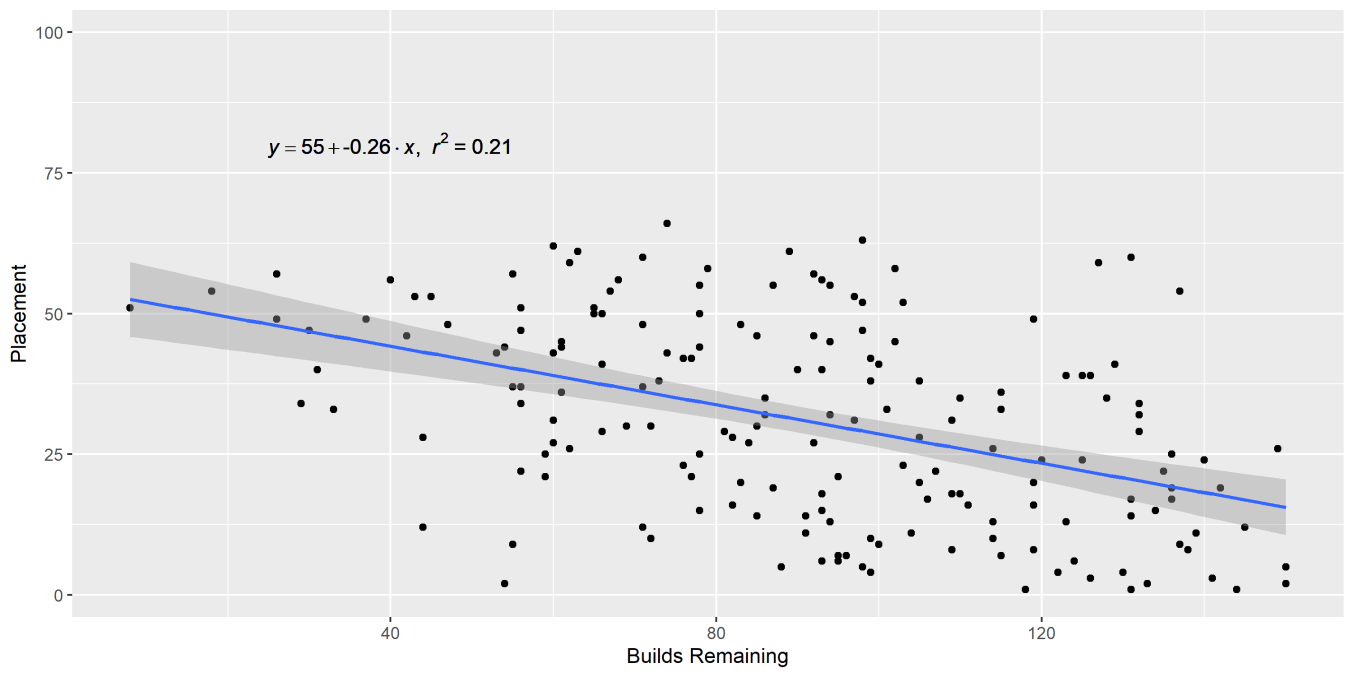
I’m not going to pretend that simply having full mats throughout a game
will guarantee you a victory royale in FNCS Grand Finals if you
currently struggle to hit the 6000 hype threshold to qualify for a
Champion League Cash Cup. But you already knew that. Here’s a
scatterplot showing the relationship between Placement and Builds
Remaining at the start of Zone 4:
Now that we have seen the type of correlation Mat Economy has with
survival/placement, we should consider what it looks like to manage your
Mat Economy well. A good place to start is to look at the median Mat
Economy for a player as the game progresses:
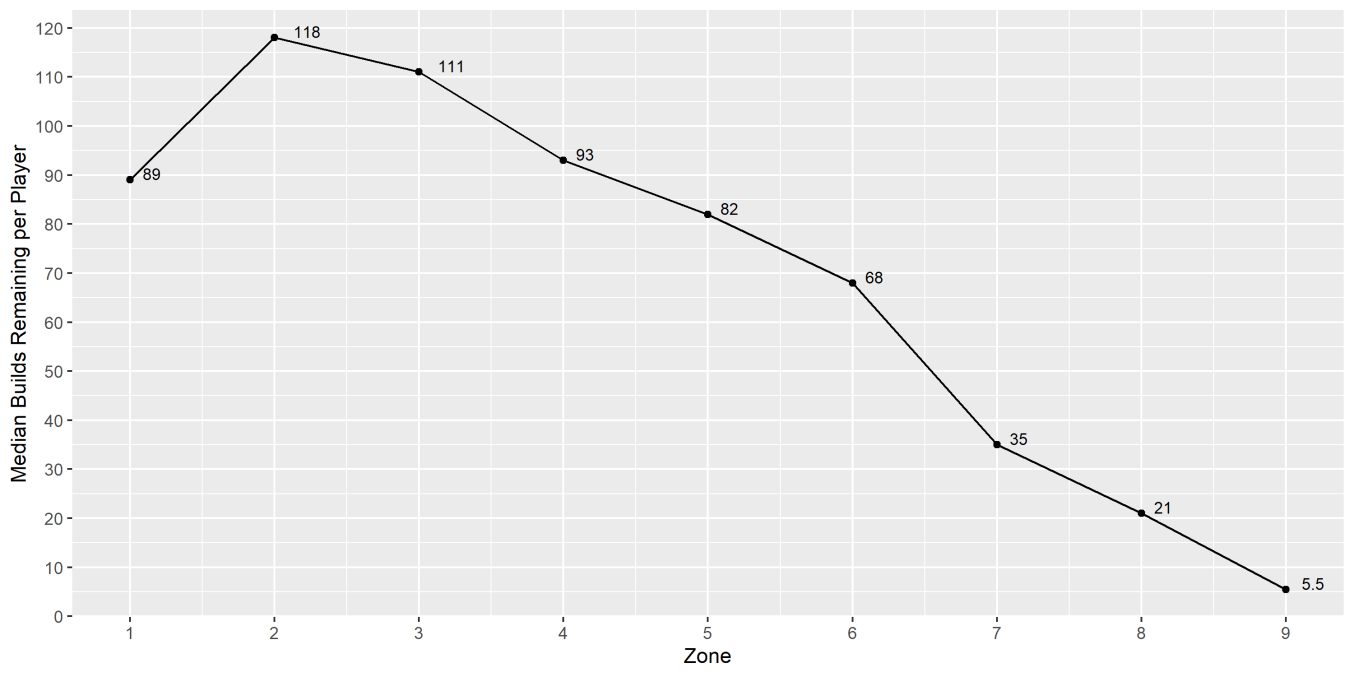
It’s clear that players generally harvest their mats early until they
reach their peak Mat Economy level around Zone 2, and then gradually use
the resources they stocked up on throughout the game with some heavy
dropoff during moving zones.
If you are a competitive Fortnite player, you are probably aware of this
general trend; however, these concrete numbers can serve as a great
guide to help you at least keep pace with the rest of the lobby when it
comes to Mat Economy. A useful exercise might be to pull up a bunch of
solo tourney/scrim replays and track your own mat count at the start of
each zone to compare. You might find that your mid-game aggressiveness
is taking a big toll on your Mat Economy, leaving you woefully
underprepared going into moving zones and frequently running out of
builds by Zone 7 or 8. Or, maybe you’re particularly good at getting
refreshes during endgame and maintain a solid mat count as the game
comes to a close.
Before we move onto the final section, it’s worth looking at how players
above the median mat count compare to players below the median in terms
of survival:
| Zone | Avg. Placement for Players Below Median Builds | Avg. Placement for Players Above Median Builds |
|---|---|---|
| 1 | 48.22 | 39.57 |
| 2 | 44.28 | 34.73 |
| 3 | 41.20 | 28.28 |
| 4 | 38.08 | 23.90 |
| 5 | 30.07 | 19.35 |
| 6 | 24.43 | 16.22 |
| 7 | 14.73 | 11.42 |
| 8 | 9.28 | 4.78 |
| 9 | 4.40 | 3.80 |
To cap off this deep dive, let’s take a look at who is good at Mat
Economy management and try to get a glimpse at what makes them
particularly good at it so we can improve our own gameplay. Below is a
list of players that had the highest avg. builds remaining above median
for each zone in the dataset (remember, this data is only from a subset
of games in NAE DH Finals):
| Zone | Top Player | Builds Above Median |
|---|---|---|
| 1 | Joji | 49.3 |
| 2 | XSET Av | 24.7 |
| 3 | JERM | 24 |
| 4 | Okis | 31.3 |
| 5 | vnsh bully iwnl | 29.7 |
| 6 | GABE | 39.7 |
| 7 | Degen | 27.3 |
| 8 | Degen | 28.7 |
| 9 | cN Simple YT | 14.2 |
We can even take it one step further and aggregate builds above median
across all zones and games to get an idea of which players are the best
at all around Mat Economy management:
| Player | Total Builds Above Median |
|---|---|
| XTRA Reet | 532.0 |
| vyx. | 400.5 |
| Gamma Th0masHD | 360.0 |
| Degen | 346.5 |
| TSM MackWood1x | 342.0 |
Of course, this is a super unrefined stat that’s bound to have some
issues, but it’s a good rough look at who may be worth learning from in
this aspect of the game. XTRA Reet takes home the top spot, and if you
VOD some of his gameplay, it’s pretty clear why.
After watching Reet’s first two games in DH Finals, I saw a number of
things working in his advantage. First, he was essentially uncontested
on his side of Stark Industries, giving him plenty of time and space to
farm mats as well as a number of transportation options. He often used a
car to rotate in the early zones to save mats while getting as close to
center as possible, minimizing future rotates. For his midgame rotates,
Reet always used movement items (bouncers, shockwaves, crash pads); this
ensured that he didn’t waste any unnecessary mats before moving zones
began.
Finally, the aspect of Reet’s play that most stuck out to me was his
willingness and ability to get late-game refreshes. While many players,
including elite ones, tend to get tunnel vision focusing on their
rotates during moving zones, Reet was constantly looking to catch other
players off-guard and use their loot to refill his materials. In the
first two games alone, he had 10 eliminations from Zone 4 on. This
elimination pace is definitely a bit unsustainable, but his knack for
picking off enemies amidst the endgame chaos is undeniable.
Reet’s formula isn’t the only viable one, and I implore anyone
struggling with Mat Economy management to seek out other top players’
gameplans. It’s fairly simple to figure out whether Mat Economy is
handicapping your overall performance, and just a few tweaks to your
strategy, such as changing what you carry in your inventory and
adjusting your early game rotates can go a long way towards improving
your ability to survive in Fortnite.
Questions? Need Help? Follow/DM me on Twitter @1UpAnalytics
Please use our Creator CODE: MOKOKIL1
Please follow and like us:


