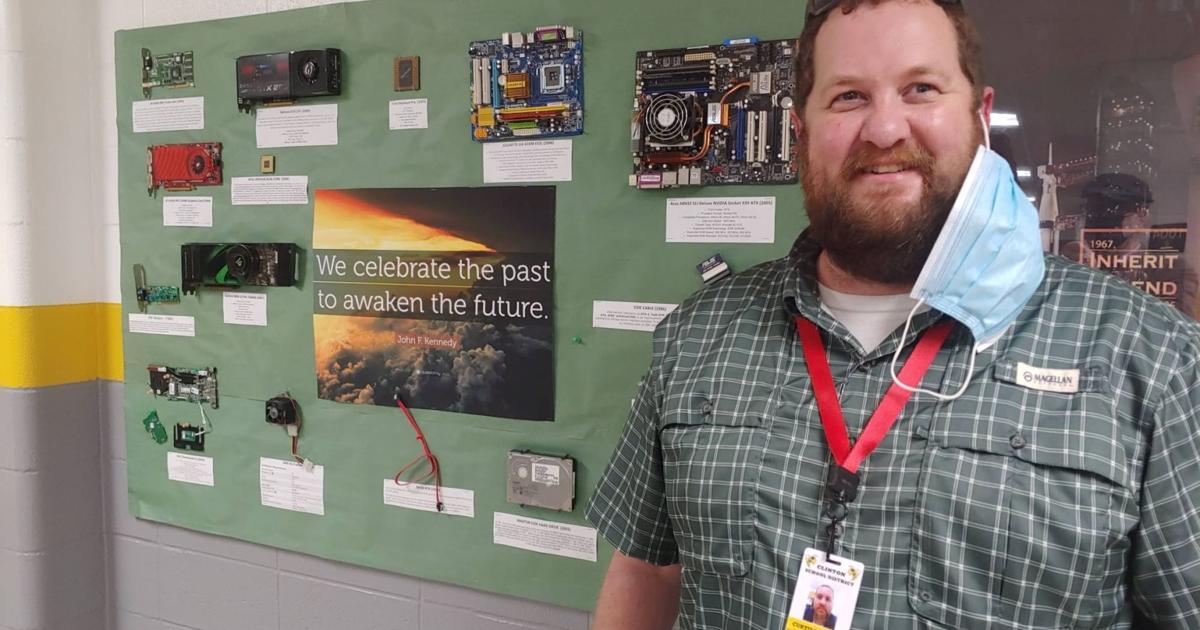
Meeting after school for sports practice is a tradition as old as, well, school, but a new form of sports has students meeting in a less-traditional arena. This particular form of competition is so new that an extra letter has been added to the “sports” title as students in this environment compete in “esports.”
Esports is played on computers, the computers networked into a central, off-sight, server (essentially a base computer). A team of plays from one site, in this case Clinton schools, networks to the server, then a second group of students from another school join the same server and the two teams compete.
Competition is centered on games of various goals, of either in-essence capturing the flag or scoring the most points via goals (sports, after all). Scoring, and ultimately winning, requires teamwork as efforts are concentrated for the most effective offense and, of course, defense.
Coach Curtis Dunham explained this as students, usually in groups of four-or-five, took their places around the room, each at a computer terminal. It was a big day that Tuesday afternoon as preseason games were underway, players getting tuned up, as it were, for competition.
Before turning to face their respective screens students, their teams formed, reviewed strategy. The language was the same clipped jargon-laden talk of players on any sports field, what they were going to do, what they didn’t want to do, what they needed everybody to do, in order to score points and ultimately win the game. More experienced players helped the less experienced as strategies were outlined.
Check with the coach that it’s okay to start, then turn to face the screen. Lights were dimmed to better see the nuance of the displayed virtual playing field. The competitors right hand was on the computer’s mouse, the left hand on the keyboard, both used in combination to maneuver, block or defend from whatever slights the playing field, or opposing players, brought forth.
Occasional quick commands or requests to other teammates: “Go left,” “Up the center,” “Watch out for that … yeah … now right,” “back off now!” and so forth. Mouse, keyboard, concentrating on the screen. In this particular game, League of Legends, small elfin robots controlled by the computer, not the game players, would fire arrows, adding a randomness to the challenge of moving across the course.
Across the room another team was playing Rocket League, soccer using race cars to move a giant ball in a curved-wall arena. A player missed his queue and his car disappeared into charred virtual carbon. A fast exhale, a mouse click, and he was back in the game with a new car.
Dunham has been coaching esports at the school for two years now, he said, the sport teaching, well, sports, the joys of teamwork, of training (as players were doing this day), and of goal setting. Scholarships were available and more coming every day as colleges engaged with esports. Tournaments take place, and division scouts watch the field of play for promising up-and-coming esport competitors.
That day one team was getting ready to play a game under a coach, and expert in the game Smash Brothers. The coach was in California and made $2 million last year playing the game, the income a combination of game winnings and sponsorship agreements, Dunham said.
Meanwhile, Dunham said, students learn, not just the sports/teamwork metric, but technology, such as computer networking and operation.
And of course, like all other school sports, fans are welcome. Games may be viewed on one of three online outlets: Twitch at twitch.tv/jacketesports Youtube youtube.com/channel /UC99CuXyru6DpK VD3U90xbmA (or search for “Clinton Yellowjacket Esports”) or Twitter twitter.com/ClintonEsports


