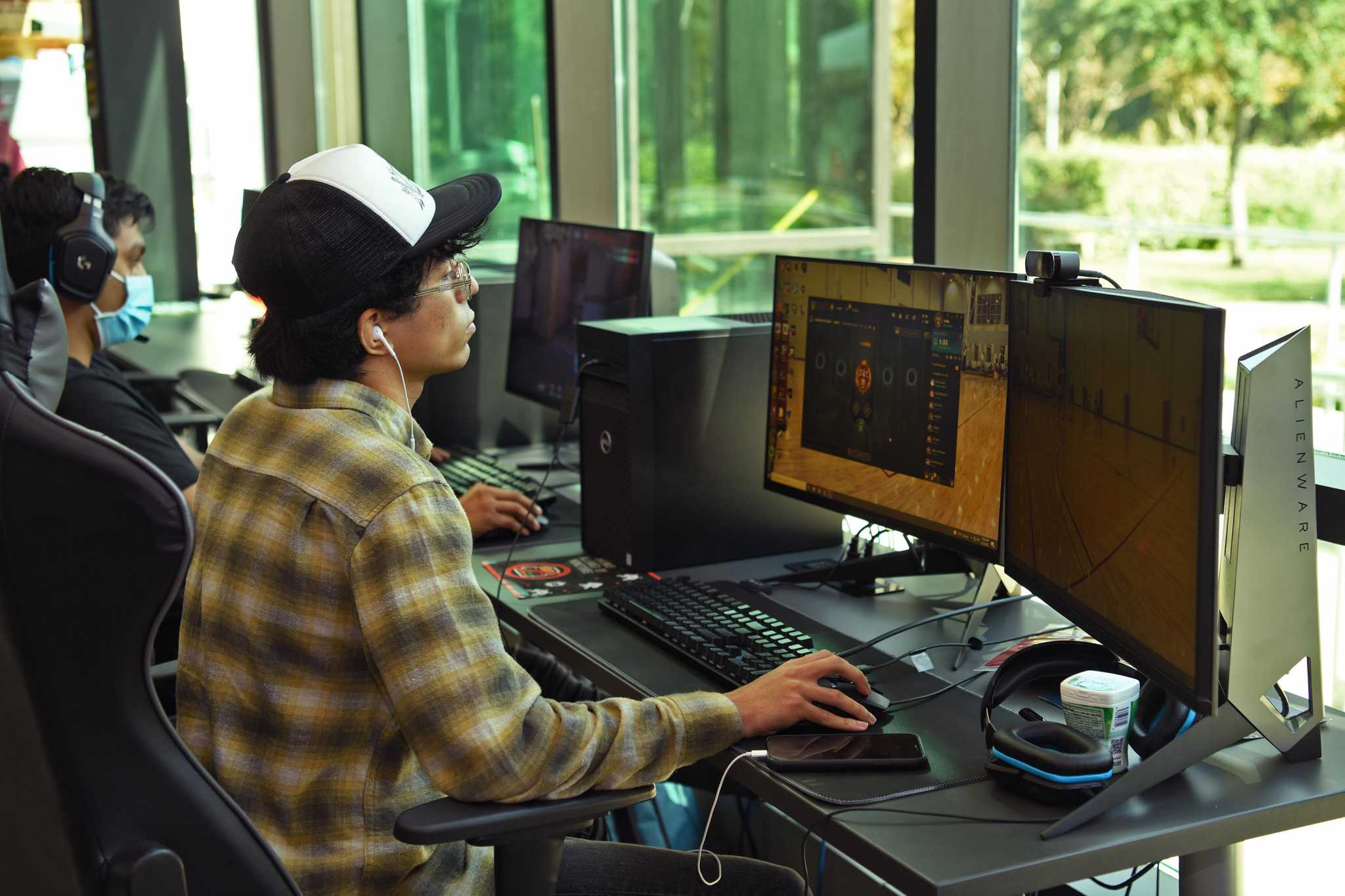
Collegiate esports — competition involving video games — has been gaining significant momentum over the past several years, and TAMIU began competing in the National Association of Collegiate Esports this fall as one of the 120 member institutions from across the country.
Between the current national esports outings as well as prior success, this has prompted TAMIU Recreational Sports Director Roberto Garza and Recreational Sports Specialist Ivan Cano to focus on expanding the program at the university as well as pioneering collegiate esports, and esports in general, in the community.
In November, members of the TAMIU Call of Duty esports team faced off against universities across the country during the NACD Starleague 2021-22 Call of Duty Playoffs. The roster included TAMIU students Rodolfo G Garza Jr (gamer tag: 100k), Nathan Hernandez (Cetra), Raymundo Herrera (Drone) and Kevin Canela (TheKevCan).
Cano added that three of the team members were from Laredo, highlighting that the talent and potential is Laredo-made. In the NACE Western Conference, TAMIU won 25 of the 28 maps played while staying undefeated until their match with Arizona State.
Going up against much larger schools like Arizona State, Central Florida, Illinois State and Minnesota State, the TAMIU team has proven that it can compete on the national level. The Dustdevils went as far as the upper finals of the playoffs. And despite losing in the lower bracket against the Canadian St. Clair College esports teams, TAMIU showed it’s a force to be reckoned with in its first competitive NACE outing.
The tournament is still ongoing, but TAMIU is shown to have won 12.5% of the $8,000 prize pool, taking home $1,000 with their fourth-place position. Split four-ways between the team members, they each take home a $250 scholarship for after their first time competing.
Meanwhile, the university still roots for its JV team as it continues playing in the NACE Starleague 2021-22 Call of Duty Rivals tournament fall semester on Saturday. TAMIU team members Iso, Zeal, Buddha, Dloading and Dudz faced off against Minnesota State University, Mankato in the upper finals but lost as they fell to the lower brackets.
The JV team will have to play and win on Sunday against either Fanshawe College or the University of Windsor. The winner will then play against MNSU at the Grand Finals on Dec. 12.
Cano said it is awe inspiring how the varsity team, who only met months prior and started playing together for equally as long, were able to compete in the varsity division against teams with larger investments and years of experience.
He added that before the tournament, 100k and Cetra joined a 2v2 tournament for a Collegiate Call of Duty League on Halloween, where they won first place in the nation against 76 universities. It is important to him that these achievements are highlighted as any other sport would throughout higher education or high school.
Call of Duty: Cold War is a first-person shooter that sees players competing in several game modes that revolve around twitch/precise aiming, holding capture points and teamwork in the competitive level. These include Hardpoint, Control and Search and Destroy, with the last mode well-known for its one-ife rounds. It was released on Nov.13, 2020 and is part of the long-running Call of Duty series that can be traced back to its first release in 2003.
What is NACE?
According to the NACE, the Starleague is the largest collegiate esports league in North America with more than 14,500 students from 600 colleges and universities. Being in its position, the Starleague is stated to provide students scholarship prizing and live grand finals events at the end of each semester after a highly competitive season.
With the prospects of an esports career available for interested students, the NACE does have several requirements to participate. Requirements include being a full-time student with a GPA of at least 2.0 that is enrolled in an accredited university or college. They define full-time as 12 credit hours per semester. This coincides with TAMIU’s requirements to participate.
“Their responsibilities first and being an athlete comes second,” Cano added.
Formed in 2016 at the first Collegiate Esports Summit held in Kansas City, the NACE hosts over 5,000 student athletes and awards over $16 million in esports scholarships. A total of 94% of the varsity esports programs are a part of NACE and the professional level, and esports as a whole is garnering bigger views and payouts.
“Taking the virtual realm by storm, Esports and Gaming has begun to make its mark on TAMIU and is ready to stay. Get involved with Rec Sports Esports and Gaming for at home or on-campus enjoyment!” TAMIU states. “Our mission is to provide more recreation services to a wider spectrum of students; as well as opportunities of community involvement, leadership, diversity and universal game play.”
Developing esports at TAMIU
The addition of esports was developed over time and was largely a student-driven initiative, Cano said. However, the continued accomplishments of the teams have led them to push for more support from the university and both the local and TAMIU community.
Garza said plans to create an esports arena at the current TAMIU game room have been discussed.
This would eventually result in approximately 20 gaming PCs that would be available for both practice and general student use. By Spring 2022, the game room will house eight gaming PCs that are tailor-made for gaming, with emphasis on games used by the NACE. Cano explained that currently there are more than eight players for the current four PCs, and the incoming machines will allow them all to practice together.
“We have more than eight players, and we would like to see them practice at the same time, practice in person, because they have been having to practice at home which doesn’t help with the team communication and the chemistry,” Cano said.
With the teams competing against teams with strong support from their universities, Garza said he wants to pursue similar investments and start a scholarship program for the esport athletes. This would be compounded by making sure that the esports teams are supported exactly like any other sport.
This may result in future sponsorships by esports-supporting companies, Garza said, adding that some day in the future, the community will see those logos on a TAMIU team jersey. He acknowledged that it would take some work to get there from the teams and both himself and Cano, but both believe that TAMIU’s program go the extra mile.
“They are student-athletes, so that’s the route that we want to take it and get to,” Garza said. “By hopefully being better known because we were ranked and won tournaments, those create opportunities for that type of excitement that is generated because of the success of the program. People want to buy into it.”
Cano also adds that one of the responsibilities of being a university involved with the NACE is to promote esports at the high school level. Both he and Garza were proud to say that during the high school tours, there was a high level of excitement from students when they mentioned their esports teams.
Furthermore, members of the teams are grateful for the chance to compete through the university and the investment made into the program. Hector Garcia Dominguez — captain and coach of the TAMIU League of Legends team — said that this semester was a testament to the talent of the teams, and the results are proof of the potential.
“I think with a little more time and effort from us, we will go to big places,” Dominguez said.
Currently, the team is practicing and preparing for the spring semester’s League of Legends tournament alongside the Rocket League and Call of Duty teams. Dominguez made it very clear the dedication is strong, and despite graduating this upcoming semester, he is sure TAMIU esports will be successful.
Both the varsity and JV team’s efforts showed a positive trend within the program as earlier this year, Ivan Larumbe — a junior Kinesiology major at TAMIU — took the title of the NIRSA Esports Tournament Champion in the Rocket League 1v1 Rec Division, TAMIU stated. They added that the virtual tournament hosted 233 students from 48 different institutions from across the U.S. and Canada.
“We have been working hard to get our university’s Esports and Gaming program off the ground,” TAMIU Associate Director of Recreational Sports Tracie Vogel said. “We only just started the program last year, and this is the first official NIRSA tournament we have entered where our players competed against other collegiate players. Needless to say, we are thrilled beyond belief that we have a champion on our first try.”
Ultimately as the students continue to shine in their tournaments, optimism surrounding an expansive and dedicated esports scene continues to grow. It may not take long until TAMIU students cheer for their fellow students online during an esports tournament.
cocampo@lmtonline.com


